By contributing reporter Jennifer Bonniwell
Wellesley Public Schools have made up much of the learning loss from the pandemic, according to newly released spring 2023 MCAS results.
Scores on last spring’s math, English and science tests have mostly returned to pre-pandemic levels.
The best news for Wellesley was for 3rd to 8th grade math scores, which had plummeted during the pandemic. Among middle schoolers this year, the percentage of students meeting or exceeding expectations on the math exam rose to 75 percent, nearly matching the 74 percent from 2019. In 2021, just 58 percent of middle schoolers met or exceeded expectations on the math exam. In 2022, the group that met or exceeded expectations improved to 67 percent, but still far lower than pre-pandemic. (There was no MCAS testing in 2020)
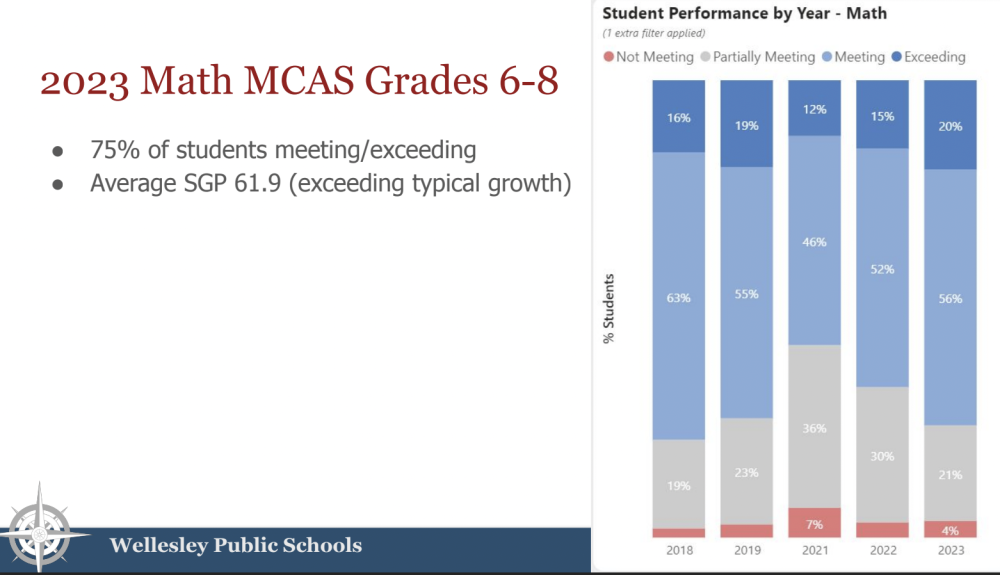
Elementary school students saw similar improvement on the math exams. This year, the percentage of students in grades 3 to 5 who met or exceeded expectations rose to 80 percent, even higher than the 77 percent in 2019. In 2021, just 67 percent of 3rd to 5th graders met or exceeded expectations on the math MCAS.
Science scores have also improved – even higher than 2019 rates. For middle schoolers, 82 percent met or exceeded expectations on the science MCAS this year, compared with 70 percent in 2022 and 79 percent in 2019. For grades 3 to 5, 73 percent met or exceeded expectations this year, compared with 68 percent in 2019.
“WPS has significantly closed learning gaps created during the pandemic,” the school district said in a statement during the remote School Committee meeting on Oct. 17 (video starting at 35:00). “WPS has met or exceeded MCAS achievement targets in nearly all areas, however, there are persistent gaps in performance of subgroups of students.”
Like in Wellesley, math scores plummeted during the pandemic across the state. However, not like Wellesley, Boston and much of the state have not yet returned to pre-pandemic achievement. The Boston Globe recently reported that just 41 percent of students grades 3 to 8 met or exceeded expectations on math MCAS tests; still 8 percentage points below 2019.
Grades 3-8 English Still an Issue
The one area Wellesley still needs to improve is English for grades 3 to 8. This year, 77 percent of middle school students met or exceeded expectations on the English test, up from 73 percent in 2021 but still 4 points below the 2019 peak of 81 percent. And for grades 3 to 5, 76 percent of students met or exceeded expectations, compared with 70 percent in 2022 and 79 percent in 2019.
Another area needing improvement is the discrepancy of test scores by ethnicity: Black and Latino students lag behind white and Asian students in scores on math and English tests at every level in the Wellesley school system. For students grade 3 to 8, 39 percent of Black students and 57 percent of Latino students met or exceeded expectations on the math test this year, compared to 77 percent of white students and 91 percent of Asian students. Similarly, on the English MCAS, 43 percent of Black students and 61 percent of Latino students in grades 3 to 8 met or exceeded expectations, compared to 76 percent of white students and 85 percent of Asian students.
Among 10th graders, 31 percent of Black students and 54 percent of Latino students met or exceeded expectations on the math test, compared with 93 percent of white students and 98 percent of Asian students. And in English, 41 percent of Black 10th grade students and 68 percent of Latino students met or exceeded expectations compared with 90 percent of white students and 93 percent of Asian students.
“We can definitely improve,” Assistant Superintendent Sandy Trach told the School Committee. “We really have to fulfill the promise of all means all. Everyone has to meet and exceed targets in every one of those ways.”
High School Scores Steady
Wellesley High School test results did not see as much fluctuation during the pandemic, and have largely remained steady for the past few years. This year, 90 percent of 10th graders met or exceeded expectations, compared to 85 percent in 2021 and 89 percent in 2019.
On the English test this year, 93 percent of 10th graders met or exceeded expectations, up from 86 percent in 2021 and 85 percent in 2019.
The Science, Engineering and Technology MCAS has only been given in 10th grade since 2022. This year, 80 percent of 10th graders met or exceeded expectations on the science test, compared with 74 percent in 2022.
High School Absenteeism
One area that has raised alarms at Wellesley High School is the increase in students who have missed 18 or more class days – a group of students whom the state classifies as chronically absent. Missing school for any reason, even when excused, can impact a student’s ability to “read at grade level, perform academically, and graduate on time,” according to the state Department of Elementary and Secondary Education.
In 2023, 15 percent of Wellesley High School – or about 216 students – missed more than 18 days of school. This is up from 14.2 percent in 2022.
Trach said the district planned to dig deep into the myriad issues that contribute to students missing school.
“For some families it’s transportation, for other families it’s annual travel, for some students it may be just reluctance to come to school consistently due to feelings of belonging. We definitely are going to need a multi-pronged strategy to support this,” Trach said. “It’s really a student-by-student matter, and it’s something that has our absolute full attention this year to work on.”
Near the Top of the State
The district happily reported to the School Committee that the 2023 MCAS achievement put Wellesley at the top of its peer districts. Wellesley is among the top two school districts in the state based on the percentage of students who met or exceeded expectations in math, top three districts in math, and top four in science. Notably, Wellesley tied with Lexington for the highest percentage of students grades 3 to 8 who met or exceeded expectations in English.

—
How I researched this article
Want to dig into the MCAS results? The Wellesley School District provided only an overview slide show during its presentation to the School Committee, and some of the key findings related to math and diverse subgroups were not discussed in detail. For this article, I also reviewed the Boston Globe’s excellent data analysis, and also the Department of Elementary and Secondary Education site here and here.