The Wellesley Historical Society highlights an object from its collection each month for The Swellesley Report. This month’s post was written by Annabel Abdelal, Curatorial Intern at the Wellesley Historical Society.
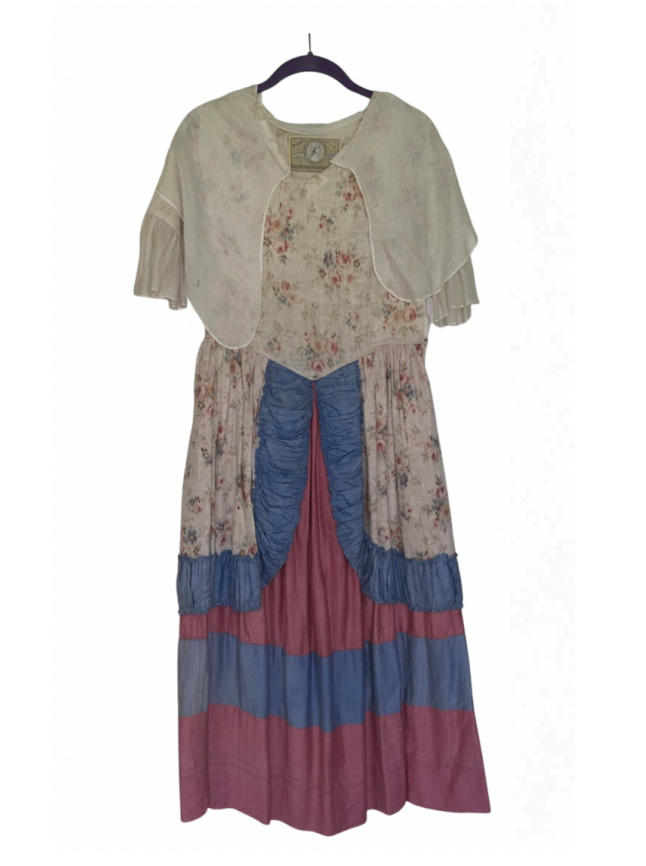
In an elaborate display of national pride, this striking dress represents a celebration much larger than fashion. Delicate floral fabric, flowing skirt, dramatic shoulder ruffles, and bold bands of red, white, and blue cascade down its front. It is a surviving artifact from the patriotic celebrations of the bicentennial of George Washington’s birth. Preserved nearly a century later, the dress offers a colorful window into how Americans commemorated shared history and national identity.
In 1932, the United States marked the 200th anniversary of Washington’s birth with parades, pageants, exhibitions, concerts, school programs, and civic ceremonies, all of which stretched from the golden coast to the eastern seaboard. Amidst the crippling hardships and uncertainty of the Great Depression, the bicentennial provided an opportunity to find inspiration in the richness of the country’s life and history. Washington occupies a distinct place in the American imagination. He was a symbol of perseverance, leadership, and national unity. Communities large and small organized elaborate celebrations, which often featured historical reenactments and colonial-inspired costumes. Dresses like these were designed to evoke an idealized vision of early America and blend historical references with the fashion sensibilities of the 1930s.
The garment’s soft floral prints recall 18th-century textiles, while the vivid patriotic colors boldly announce its purpose. The piece is both theatrical and sincere as a wearable expression of civic pride and a transformation of history into living experience. The 1932 bicentennial spirit was quite different from that of the nation’s better-known bicentennial celebrations of 1976—the commemoration of 200 years of American independence. The Washington bicentennial emphasized reverence. Americans largely viewed the founding generation through a heroic lens, and public celebrations brought unity and shared ideals to the spotlight. By contrast, the 1976 bicentennial arrived after decades plagued by political upheaval, the Vietnam War, and dramatic social change. Americans still celebrated enthusiastically—with tall ships, fireworks, community festivals, and an explosion of patriotically colored memorabilia—but there was also a greater willingness to examine history from multiple perspectives.
Despite their differences, the anniversaries shared a common purpose: an invitation to reflect on whence we came and where we were headed. Whether through a colonial-inspired dress in 1932 or a bicentennial parade in 1976, ordinary citizens became participants in a national conversation about identity, memory, and belonging. This dress is evidence of how history was interpreted and worn. Its faded fabrics and exuberant colors remind us that every generation finds ways of honoring the past. The outfit tells a vivid story about Washington, the Americans who celebrate him, and the enduring desire to connect with history through celebration, creativity, and community.
Every month, the Wellesley Historical Society highlights an object from its collection. These objects capture Wellesley stories, both those well-known to us and those yet uncovered. Historic artifacts symbolize and convey important narratives, whether that is the hard-working craftsman behind a piece or a written document that shaped the town’s future. As such, the Wellesley Historical Society collections capture the entirety of Wellesley as a town, from significant happenings to sentimental mementos.
This month’s post was written by Annabel Abdelal, Curatorial Intern at the Wellesley Historical Society.