 Thank you to education writer and guest columnist Martha Collins of Admit Fit College Admissions Counseling for the following post. Need guidance navigating the college admissions process? Whether it is sage advice, expert edits or admissions interview prep, Admit Fit can help. Contact (781) 237-7770 or visit www.admit.fit.
SPONSORED CONTENT—AP courses can demonstrate academic rigor in high school, which is useful for your college applications. But many students may not appreciate that those AP exam scores have significant value once you get to college. And note, sometimes you can take an AP exam even if you did not take the AP course, or even if your high school does not offer the AP exam.
One of the biggest benefits of earning AP credit is you may not have to take as many courses during a particular semester once you are in college. For example, if a college awards you eight credits for a strong AP Calculus BC score, those credits may allow you to skip introductory courses and create room in your schedule. Instead of taking five courses in a semester, you might be able to take four.
That extra flexibility can mean more time for:
- Having a more manageable academic workload
- A demanding course in your major
- An internship, research or other experiential opportunity
- A second major or minor
- Athletics or extracurricular activities
- Studying abroad
Most importantly, accumulating enough AP credit may also allow you to graduate early or reduce the number of semesters of full-time enrollment.
Different colleges, different credit systems
But AP credit doesn’t work the same way at every university. Some colleges award credit that counts toward the credits required for graduation. Others primarily use AP scores for placement—for example, allowing you to skip an introductory course, but requiring you to replace it with another course. At some colleges, an AP course may satisfy a requirement within a major. And at still others, AP credit may count only as an elective or toward general education requirements.
For example, the University of Michigan allows AP credit to be used in different ways, depending on the exam and academic program. Some AP credits can fulfill major or minor requirements, while others count only toward total graduation credits or provide placement into higher-level courses.
At Tufts, AP credit is treated as course credit toward degree requirements, and some AP exams provide direct course equivalents. A 5 on AP Biology, for example, earns specific introductory biology course credit, while a 5 on Calculus BC earns eight credits.
University of Virginia explicitly says non-course-equivalent AP credits count as elective credits toward the degree, but do not satisfy General Education Requirements.
Boston College explicitly states AP units may fulfill core, major or minor requirements, but are not awarded as credit toward graduation. But 30 AP units can make a student eligible for Advanced Standing and potentially a three-year degree.
At Tulane, AP credit can satisfy proficiency requirements only in Formal Reasoning and Foreign Language; other AP credit generally counts as general elective credit.
UMass Amherst awards actual course equivalents for many AP exams: a 4 or 5 on Calculus BC earns 8 credits for Math 131 and 132. The university recommends students consult their undergraduate advisor about AP credit in their specific major.
Opting in, opting out
Another important point: reporting your AP scores to colleges during the college application process is typically optional, unless you want colleges to consider them for admission purposes.
But if you want AP credit or placement at the college you will attend, that college needs your official AP score report. College Board recommends sending scores no later than July of senior year. Check the policy for the college you will attend carefully.
College Board does not require students to take an AP course before taking its exam. If you are a strong student in the subject matter, consider preparing independently and taking the AP exam. And if your school does not offer the AP exam you want to take, you can arrange to take it at another local high school that administers the exam. Search the College Board AP Course Ledger, contact the school’s AP coordinator, ideally before mid-November, and ask whether the school accepts outside students.
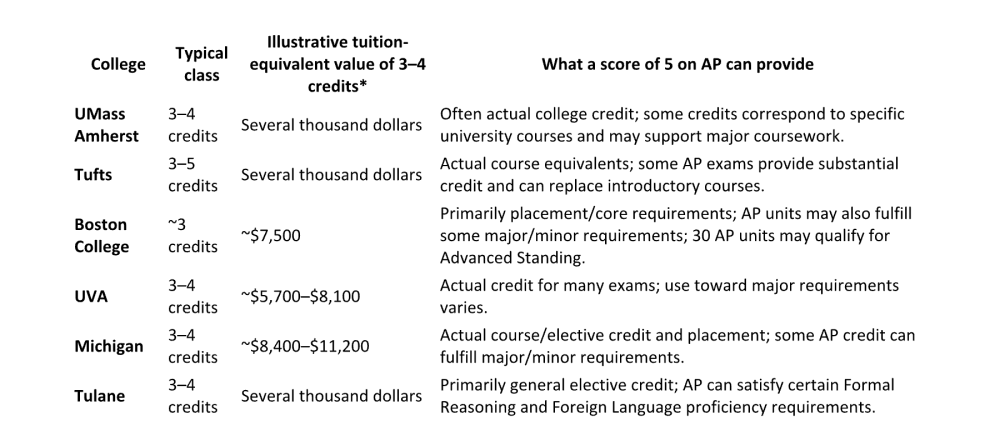
Tuition-equivalent figures are illustrative estimates, not amounts that a student automatically saves by earning AP credit. Most full-time students pay a flat tuition charge, so the financial benefit depends on how the student uses the AP credit.
The AP exam fee is $99 in the U.S. for 2026–27. A strong AP score may earn you college credit, course placement, allow you to take a lighter course load while remaining on track for graduation, graduate a semester early, or otherwise reduce the number of semesters you pay for.
Need guidance when considering your AP strategy, tailoring your target school list, or crafting your personal statement essay? Contact www.Admit.Fit at (781) 237-7770.





Leave a Reply