In Massachusetts, when a student with a disability turns 22, their eligibility for special education services concludes and the state refers them to the Department of Developmental Services’ (DDS) adult agencies, as per the Commonwealth’s Chapter 688 law. However, some local advocates believe this system is flawed.
One such advocate is Wellesley resident Kathryn Donald Stanley, co-founder and board president of High Spirit East Community, a nonprofit organization aiming to build family-style, work-life residential communities for adults with intellectual, developmental and physical disabilities and their caregivers.
Stanley has a daughter named Ellie, who has cerebral palsy. For a long time, she researched what would happen to Ellie when she ages out of school, but Stanley said she wasn’t satisfied with the options.
Stanley said the growing population of adults with disabilities is outpacing available infrastructure, leaving some families to continue providing care at home, while existing care settings can sometimes leave people vulnerable to abuse.
“I love Ellie so much, and I just need to know that she’s going to be safe and loved and not abused and neglected in the future,” she said.
Her proposed solution is the “supportive neighborhood” model, in which adults with disabilities and caregivers share their lives in a family-style setting, rather than relying on the traditional shift-work care setting.
“There’s a slight hierarchy, but there’s not an executive director telling everybody what to do, because then it wouldn’t be mimicking a family home,” she said.
Stanley said the organization drew inspiration from High Spirit Community Farm, the state’s first pilot program for the model, which was founded by Bob Swain in 2004 and has lasted since with “zero abuse.”
High Spirit East Community aims to use this framework to build three “fairly large” accessible houses on a four-acre plot, with six to seven people living in each house, she said.
Stanley said the lifestyle of those living in these communities is intended to mimic adult family life. At High Spirit East Community, residents will maintain the grounds through permaculture, help with household chores and engage with the arts — at an appropriate pace for those with disabilities, she said.
The combined, estimated cost to build the houses, greenhouse and art center is $5 million. Once the community is built, the funding will be “sustainable” because the DDS will financially support each resident with a disability and their caregivers, she said.
However, the problem is that an upfront investment for the neighborhood’s construction is required before it is eligible for DDS funding, she said.
The nonprofit has begun raising money for the project — with some board members already contributing — while also exploring loans from the U.S. Department of Agriculture, Stanley said.
Pushing for state support
At the same time, the organization is advocating for the “supportive neighborhood” model to qualify for the state’s Facilities Consolidation Fund, which provides funding to community-based housing for clients of the DDS and the Department of Mental Health.
Currently, funding allocations through DDS are limited to specific categories, such as group homes, shared living facilities and foster care — Stanley aims to expand that.
In June, the nonprofit was invited by State Sen. Robyn Kennedy for a legislative briefing, in which Stanley, alongside Swain and Marc Charney, a director for High Spirit East Community, advocated for the “supportive neighborhood” model to become a category eligible for state funding.
“We’d like to see supportive neighborhoods become as ubiquitous as group homes,” Stanley said.
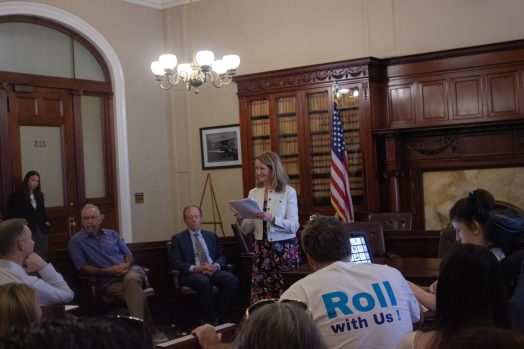
Since the briefing, DDS began holding listening sessions with interested parties on a potential new life-sharing program model that would “more accurately create program requirements and a rate structure that supports the life sharing programs that are already in operation and promote high quality service delivery and consistency,” the agency wrote to Stanley on Oct. 6.
“What it did is it launched things into action,” Stanley said of the June briefing. “It elevated the conversation and gave a lot of people, [like] the families that were there, hope.”
Group homes can be unsuitable for people with high support needs, such as Ellie, who uses a voice-output device, Stanley said. The “supportive neighborhood” model aims to specifically accommodate those with more complex support needs, she said.
She also said she believes the shift-work model used in many existing care settings, along with low caregiver wages, can contribute to inconsistent care and leave people with disabilities vulnerable to abuse.
A major goal of the “supportive neighborhood” model is to eliminate this by promoting a “life-sharing” dynamic between the caregivers and the residents with disabilities.
“The minute somebody is paid and their only role is to take care of somebody else … the person being cared for becomes an object,” she said.
However, she said, despite the flaws in DDS’s system, there is no “bad guy,” and the department is working to make improvements.
“I don’t want to put DDS on the back foot, because they have been collaborating, and I think they’ve been overwhelmed too,” she said. “It’s not their fault.”
Stanley said she hopes that High Spirit East Community enables those with high support needs to become active members of a community without any limitations.
“They all have these rich inner lives and intelligence that they’re fighting their [cerebral palsy] to get out into the world, and they shouldn’t have to do that,” she said of Ellie and other adults she knows with cerebral palsy. “They should have things that are accessible.”
More: Wellesley Executive Director said during the town’s recent workshop about the future of the North 40 property that “We’ve also been hearing a lot of need from many residents in our community for community-based housing for adults with intellectual and developmental disabilities. This is a specific type of housing that’s that we have heard [about] from multiple families in town as their younger children begin aging out of the school processes and need to live independently.” (See “Wellesley imagines what North 40 can do for community going forward”)
Please consider supporting your local news source with a tax-deductible donation