The town of Wellesley held its All Board Meeting on Sept. 29 to preview the FY28 budget (for the fiscal year starting next July) and emerging cost drivers. This tidy meeting lasted under an hour, and you can review the whole thing on Wellesley Media.
Wellesley Executive Director Meghan Jop acknowledged at the start that departments are just getting going on their budgets, but that this was an opportunity for town leaders to share any relevant updates to help the town prepare to set budget guidelines.
From the town side, highlighted budget drivers included the fact that all town and school unions are in contract negotiations, while the town also seeks to nail down its health insurance agreement through West Suburban Health Group that needs to be negotiated with the unions. It’s possible some contracts could be settled by the time Special Town Meeting takes place in November, Jop said.
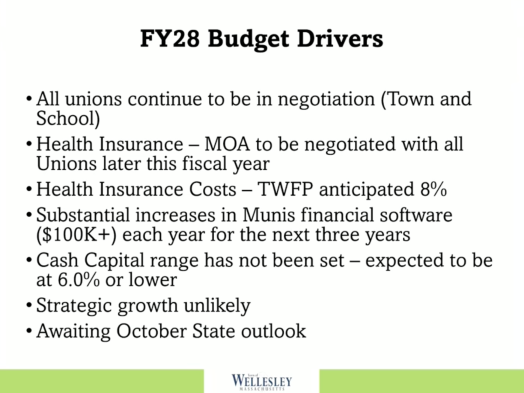
One surprise is a $100k+ per year increase for the next three years in the cost of Munis financial software, a product that’s being transitioned to a cloud computing service. Wellesley has been in communications with other municipalities and partners to determine whether there might be a way to get better pricing, as the cost appears to vary greatly from one community to the next. This could even lead to the Office of the Inspector General, Jop said. Other technology costs are on the rise as well, and that includes those for specific departments, like the library, for example.
The town’s looking to take a more conservative approach to cash capital, as it focuses on its personal services costs during this union negotiations year. Cash capital has been in the area of 6.8% of the budget in recent years, though last year it was under 6% and that could be the case again. “This year we need to set expectations early,” Jop said. Investing in strategic growth, such as new people or programs, is unlikely, she added. The town continues to try to reduce its reliance on free cash to cover operating expenses, as the state advises, but Jop said that could be challenging for FY28 in light of the new staff contracts being negotiated.
Following Jop’s preview, other department heads were invited to take the mic with any updates of their own. Department of Public Works Director David Cohen went first and said the DPW anticipates a level services budget (intended to provide the same level of service as the previous year), though has an expiring 5-year trash contract that he says could increase by about 8%. On the enterprise fund front, he said the department is looking at a possible 15% water rate increase and a 4% sewer rate hike.
Niki Ofenloch, chair of the School Committee, spotlighted capital projects, including a request for air conditioning design funds for four schools at Special Town Meeting and the near completion of the modular team room facilities at the high school track and field.
A School Facilities Task Force has been established to look at facilities needs, from the Upham building to pre-school, for the next 20 or so years; plus, a new transportation contract is in the works. A section of the School Committee website is now devoted to Wellesley Public Schools collective bargaining, and on the horizon are possible staffing implications related to new state graduation requirements, Ofenloch said.
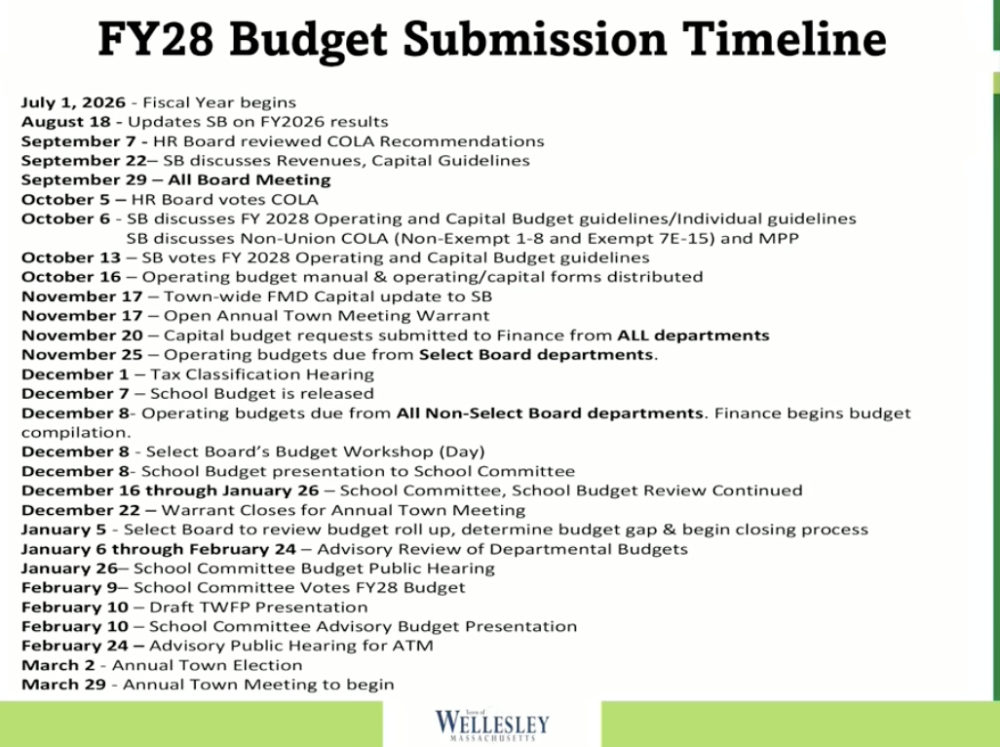
For those of you who want to follow along on the budget timeline, here you go:
Before the All Board Meeting ended, Select Board member and Capital Planning Committee (CapCom) chair Colette Aufranc shared an update on CapCom, a standing advisory group to the Select Board that met for the first time in June and then again on the night before the All Board Meeting (see Wellesley Media recording).
CapCom is designed to help the town navigate a daunting number of possible large capital projects over the next 5 to 10 years. This week’s CapCom meeting included a rundown of civil and site projects presented by DPW Director Cohen, from reconstruction of Great Plain Avenue to a Wellesley Square revamp, as well as updates on financial policies and project proposal and evaluation forms.
Please consider directing your free cash to support Swellesley’s work by making a tax-deductible donation.





Why isn’t anyone talking about the 34% projected property tax increase in 10 years? Is Wellesley’s long term plan to pay for this to just keep raising property taxes? Where is the fiscal responsibility?
Why wouldn’t a Wellesley Resident want to pay more for real-time information sharing across jurisdictions, via the cloud? If costs increase $100k plus a year, for “community safety” then who are we to pooh pooh the cost? AI priority based budgeting, what could go wrong? Would AI budgeting be prioritizing AI interests over Human interests? Human based priority budgets are passe.