• Sign up for free email newsletter
  • Advertise
  • Donate to support our work
  • Events calendar
  • About Us
 
Pinnacle, Douglas Elliman, Wellesley
 
Wellesley Hills Dental

The Swellesley Report

Since 2005: More than you really want to know about Wellesley, Mass.

  • Restaurants, sponsored by black & blue
  • Camps, sponsored by NEOC
  • Wellesley Square
  • Private Schools, sponsored by Prepped and Polished
  • Public Schools, sponsored by Sexton
  • Preschools, sponsored by Longfellow, Wellesley
  • School news
  • Kid stuff
  • Top 10 things to do
  • Business news
  • Worship
  • Letters to the editor
  • Guidelines for letters to the editor
  • Live gov’t meetings
  • Sports schedules & results
  • Deland, Gibson’s Athlete of the Week
  • Deaths
  • Housing
  • Medical providers—sponsored by FIXT Dental
 

Top Stories

Air conditioning & EV buses inform School Committee’s Special Town Meeting articles
Paying tribute to loooongtime DPW employee Smitty Rogers
Yet more new fitness & wellness studios

Advertisements

Needham Bank, Wellesley
FIXT
Down Under, Wellesley
August 2026: Object of the Month

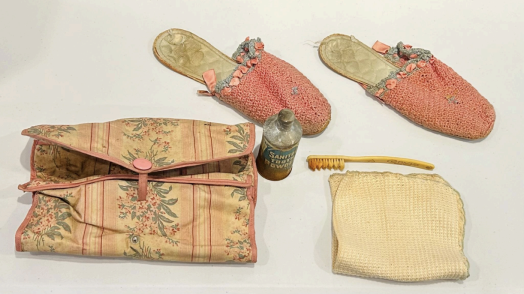
Wellesley Historical Society digs into a 1922 toiletry bag

August 3, 2026 by admin

A modern nighttime routine is familiar to most of us: a cotton towel to dry a washed face, a dollop of toothpaste, a carefully detailed pajama set. What is incredible, though, is the difference a century makes in the most ordinary of habits. When we think of the changes in daily life from the 1920s to the 2020s, we think first of the obvious: automobile transformation, civil rights expansion, and (lately!) inflation. Yet some of the most fascinating cultural shifts are reflected in the smallest of objects, even the contents of a toiletry bag.

Toiletry Bag, 1922
Toiletry Bag, 1922

Let’s consider the toothbrush. In the early twentieth century, toothbrush manufacturers primarily whittled handles from animal bone or wood, while horse or boar hair mostly comprised the bristles. Affordable toothbrush options were imported largely from Japan in massive quantities with little packaging or sanitary precautions. Because of the expensiveness of the materials and product, almost 80% of Americans brushed their teeth with a rag or toothpick instead. In the midst of rising industrialization and market competition, employers began to encourage dental health in hopes of a more healthy and productive workforce. American oral hygiene was transformed later in 1938 with the invention of the modern synthetic nylon technology we know today. Perhaps the most bizarre of the toiletry bag’s contents is the toothbrush’s partner: tooth powder. Composed of ingredients like chalk and baking soda, the abrasive powder was the most common way to brush away stains in the early years of American dental hygiene.

The crochet slippers tell yet another story. Fashion underwent a major transformation during the 1920s. The popularization of comfort led to dramatic changes in trending styles. The rigidity of previous decades gave way to an era that valued relaxation with the rise of loungewear. Slippers became popular after World War I as comfortable indoor footwear; before homes obtained central heating, residents opted for warm, snug alternatives to formal shoes. Their soft construction and practical design reflected the growing preference for garments that emphasized ease of movement and everyday comfort. Crochet slippers, often handmade, highlighted the continued importance of domestic crafts in shaping household life during the decade.

Taken together, these humble items reveal how much a century of change can be hidden in the routines we barely stop to consider. A toothbrush, a container of tooth powder, or a pair of crochet slippers may seem ordinary, yet each reflects larger developments in technology, industry, health, and culture. The transition from handcrafted materials to mass-produced synthetics, from necessity to convenience, from rigidity to comfort, illustrates how Americans’ expectations of daily life evolved. By looking more closely at the contents of a mere toiletry bag, we gain a richer understanding of a world that was both surprisingly familiar and remarkably different from our own.

We encourage you to visit the Wellesley Historical Society at 323 Washington Street to see our new exhibit, “A Time of Revolution,” where you can see this piece of history and many more!

Every month, the Wellesley Historical Society highlights an object from its collection. These objects capture Wellesley stories, both those well-known to us and those yet uncovered. Historic artifacts symbolize and convey important narratives, whether that is the hard-working craftsman behind a piece or a written document that shaped the town’s future. As such, the Wellesley Historical Society collections capture the entirety of Wellesley as a town, from significant happenings to sentimental mementos.

This month’s post was written by Annabel Abdelal, Curatorial Intern at the Wellesley Historical Society.


Filed Under: History, Wellesley Historical Society Object of the Month


Advertisements

black & blue, Wellesley
Olive Tree Medical, Wellesley
Haskins Automotive, Wellesley
MIT Museum, Cambridge
July 2026: Object of the Month

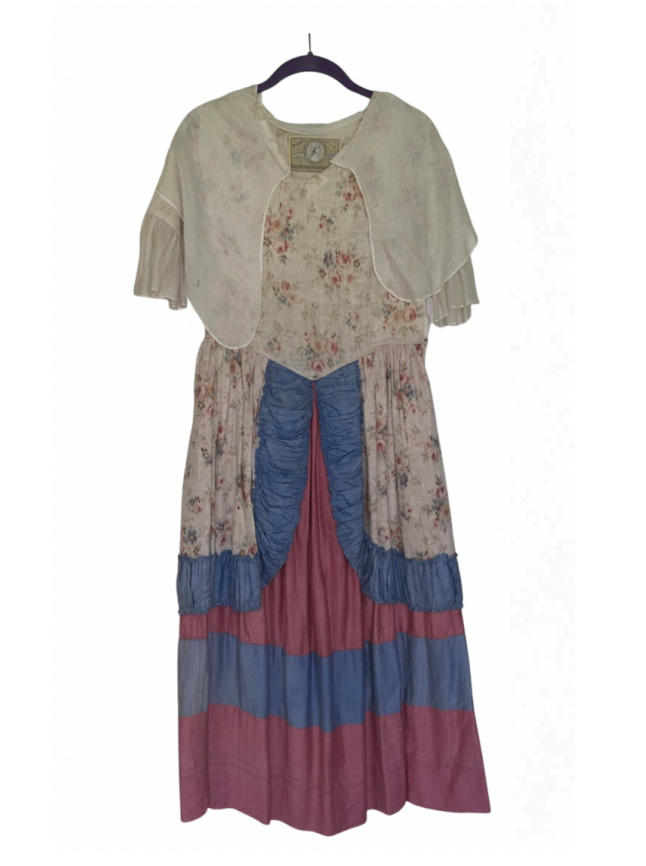
Dress from George Washington Bicentennial (1932) in Wellesley Historical Society collection

July 7, 2026 by admin

The Wellesley Historical Society highlights an object from its collection each month for The Swellesley Report. This month’s post was written by Annabel Abdelal, Curatorial Intern at the Wellesley Historical Society.

Dress from George Washington Bicentennial, 1932

In an elaborate display of national pride, this striking dress represents a celebration much larger than fashion. Delicate floral fabric, flowing skirt, dramatic shoulder ruffles, and bold bands of red, white, and blue cascade down its front. It is a surviving artifact from the patriotic celebrations of the bicentennial of George Washington’s birth. Preserved nearly a century later, the dress offers a colorful window into how Americans commemorated shared history and national identity.

In 1932, the United States marked the 200th anniversary of Washington’s birth with parades, pageants, exhibitions, concerts, school programs, and civic ceremonies, all of which stretched from the golden coast to the eastern seaboard. Amidst the crippling hardships and uncertainty of the Great Depression, the bicentennial provided an opportunity to find inspiration in the richness of the country’s life and history. Washington occupies a distinct place in the American imagination. He was a symbol of perseverance, leadership, and national unity. Communities large and small organized elaborate celebrations, which often featured historical reenactments and colonial-inspired costumes. Dresses like these were designed to evoke an idealized vision of early America and blend historical references with the fashion sensibilities of the 1930s.

The garment’s soft floral prints recall 18th-century textiles, while the vivid patriotic colors boldly announce its purpose. The piece is both theatrical and sincere as a wearable expression of civic pride and a transformation of history into living experience. The 1932 bicentennial spirit was quite different from that of the nation’s better-known bicentennial celebrations of 1976—the commemoration of 200 years of American independence. The Washington bicentennial emphasized reverence. Americans largely viewed the founding generation through a heroic lens, and public celebrations brought unity and shared ideals to the spotlight. By contrast, the 1976 bicentennial arrived after decades plagued by political upheaval, the Vietnam War, and dramatic social change. Americans still celebrated enthusiastically—with tall ships, fireworks, community festivals, and an explosion of patriotically colored memorabilia—but there was also a greater willingness to examine history from multiple perspectives.

Despite their differences, the anniversaries shared a common purpose: an invitation to reflect on whence we came and where we were headed. Whether through a colonial-inspired dress in 1932 or a bicentennial parade in 1976, ordinary citizens became participants in a national conversation about identity, memory, and belonging. This dress is evidence of how history was interpreted and worn. Its faded fabrics and exuberant colors remind us that every generation finds ways of honoring the past. The outfit tells a vivid story about Washington, the Americans who celebrate him, and the enduring desire to connect with history through celebration, creativity, and community.


Every month, the Wellesley Historical Society highlights an object from its collection. These objects capture Wellesley stories, both those well-known to us and those yet uncovered. Historic artifacts symbolize and convey important narratives, whether that is the hard-working craftsman behind a piece or a written document that shaped the town’s future. As such, the Wellesley Historical Society collections capture the entirety of Wellesley as a town, from significant happenings to sentimental mementos.

This month’s post was written by Annabel Abdelal, Curatorial Intern at the Wellesley Historical Society.

Filed Under: History, Wellesley Historical Society Object of the Month

Page Waterman, Natick
London Harness, Wellesley
Longfellow, Wellesley
June 2026: Object of the Month

Examples from the Wellesley Historical Society fan collection

June 1, 2026 by Morgan Stevenson-Swadling

As spring blooms into summer, it is only appropriate that we take a look at one of the most beautiful, intricate, and popular ways of staying cool from over 100 years ago — the handheld fan!

Since their invention, handheld fans have been a coveted accessory of high society. Their designs and materials shifted with fashion and social trends, yet they consistently remained objects of artistry and elegance. Folding fans appeared in Europe in the late 16th century, and by the 18th century, they had become so popular that both men and women carried them.

These graceful accessories, often crafted of ivory, lace, or silk, also conveyed meaning through a “language of the fan.” A flick of the wrist or subtle twirl could signal interest, intrigue, or dismissal, all without a word being spoken. Beyond their social utility, fans stood as symbols of refinement, affluence, and style, remaining fashionable well into the mid-20th century.

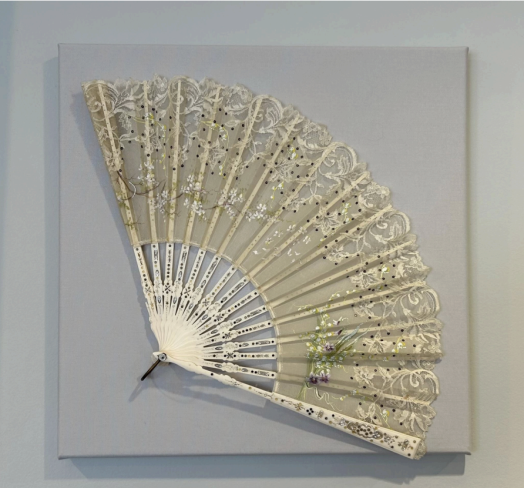
These examples date from the late 19th century. As Victorian fashions introduced larger bustles and more voluminous gowns, fan sizes expanded to match. Their slim, lightweight sticks — typically made of ivory or wood — supported leaves of gauze, lace, or silk, often painted with naturalistic designs such as flowers, birds, or butterflies, and occasionally enhanced with glittering steel or silver spangles. Over the span of 10 years, these late Victorian fans have both similarities in their designs and differences as aesthetic interests changed and evolved.

Painted Lace Fan, 1875

Lace sits on delicately carved ivory sticks for this stunning fan from 1875. Finely decorated with purple blooms and sprigs of bluebells, the painted elements interact with and play with the floral patterns woven into the lace itself. Additionally dotted with small silver decorations, this fan is a fascinating study of using multiple techniques to beautify an object with a largely “practical” purpose.

Green Silk Fan Hand-Painted
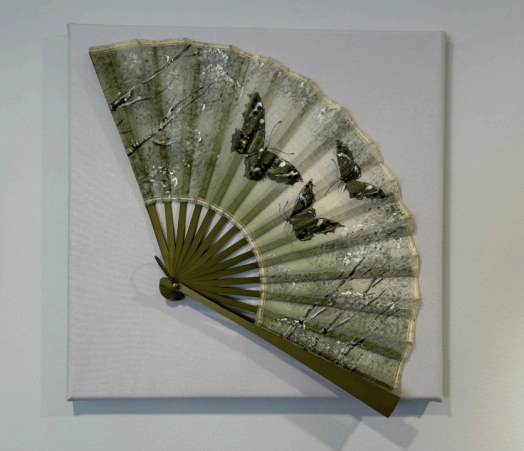
Green Silk Fan Hand-Painted with Butterflies, 1882

Green silk and painted wood craft the body of this fan, hand-painted with nature motifs and butterflies. In the late Victorian era, butterflies were a popular symbol, particularly for jewelry and accessories. The butterfly was believed to represent the soul, and was a source of Victorian fascination due to its metamorphosis, thought to be comparable to human growth and transformation. The butterfly was also used frequently in Japanese art, another Victorian interest. While the butterfly held symbolic weight and intrigue, we can also understand it as an aesthetic and fashionable motif: one can picture the butterflies on this fan “moving” through the air as the fan was waved back and forth!

Fan with Hand-Painted Floral Motif, 1885:
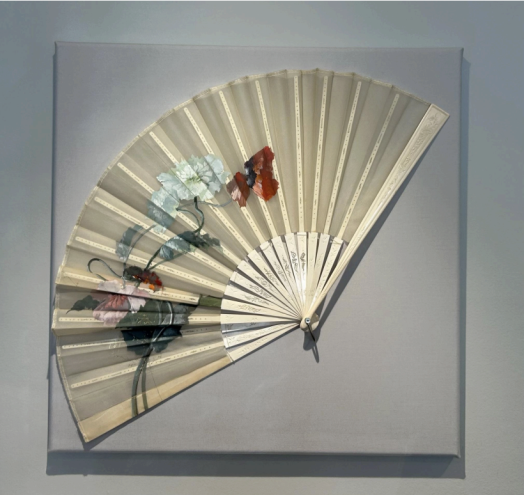
Fan with Hand-Painted Floral Motif, 1885

This 1885 fan is constructed of hand-painted lisse displayed on finely carved ivory sticks. The fan’s bones are intricately carved, but the fabric itself is kept simple except for the vibrant burst of flowers stretching across the fan’s body. Though the fan dates before the Art Nouveau style developed and took hold, the long lines, asymmetrical design, and Japanese-inspired flowers are all deeply reminiscent of the style.

The Wellesley Historical Society hosts a vast collection of accessories, dating from the late 18th-century until now. These three fans, along with several others, are currently on display in our exhibition Wellesley Through Time, up through June 17th, 2026. Stop by for a last chance visit!

Every month, the Wellesley Historical Society highlights an object from its collection. These objects capture Wellesley stories, both those well-known to us and those yet uncovered. Historic artifacts symbolize and convey important narratives, whether that is the hard-working craftsman behind a piece or a written document that shaped the town’s future. As such, the Wellesley Historical Society collections capture the entirety of Wellesley as a town, from significant happenings to sentimental mementos.

More: Past Object of the Month posts


Sign up for Swellesley’s free weekday email newsletter

Filed Under: History, Wellesley Historical Society Object of the Month

May 2026: Object of the Month

Greeting Cards from the Wellesley Historical Society Collections

May 6, 2026 by Morgan Stevenson-Swadling

The “golden age” of greeting cards spanned from the late Victorian period into the Edwardian period. In the mid-19th century, greeting cards and postcards became more accessible and affordable due to improvements in printing technology. As sending and receiving postcards became more commonplace, their design grew to become more elaborate, with elements such as lace, fabric, and gilting emerging as trends.

Greeting cards and postcards are a fascinating example of how we have communicated across time. Their featured art and design can also tell a larger story of popular symbols, motifs, and cultural interest in a given time period. For May’s object of the month, we take a look at four greeting cards from the Wellesley Historical Society’s archives.

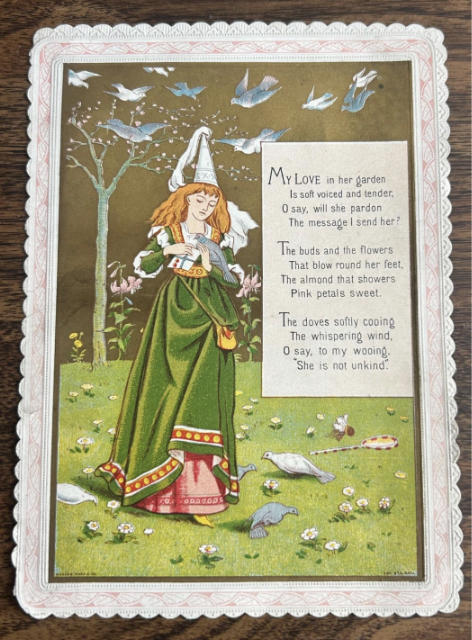
Valentine’s Day Card, Late Victorian Period:

Valentine’s Day Card, Late Victorian Period:
Photos from Wellesley Historical Society

.
This storybook-esque Valentine’s Day card was produced by Marcus Ward & Co., an Irish publishing company active from 1833 to 1899 that was known for its illustrated books for children and adults. Marcus Ward & Co. began producing cards from the late 1860s onward to massive success, employing famous and beloved children’s book illustrator Kate Greenaway. Marcus Ward & Co. cards have been preserved in museums across the world, notably the V&A Museum in London.

This lace-trimmed card features a maiden in medieval garb, a dove and a love letter, implied to have just been received from a suitor, settled within her arms. The card leans into nature motifs as comparison to blossoming affection, with flowers budding along the bare tree in the background and blooms appearing in the grass. The picturesque image is accompanied by a poem, in which the suitor is reassured by the doves that his paramour’s heart is not unkind to him.

Birthday Card, 1911:

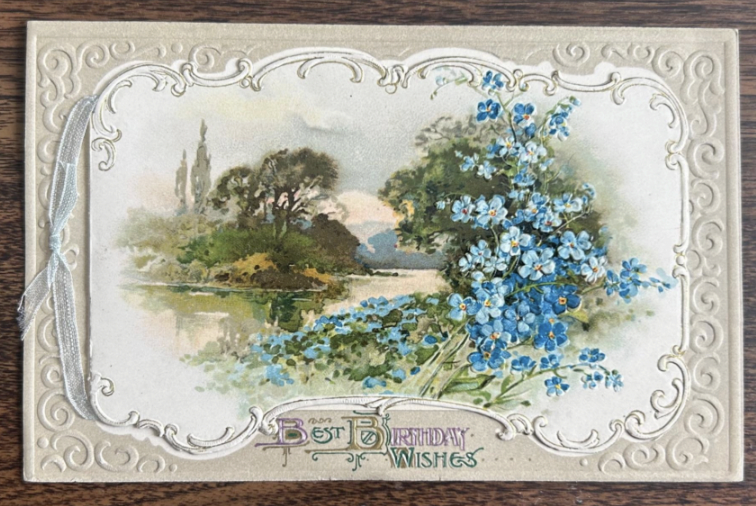
Birthday Card, 1911

This spring-like birthday card was sent to a Miss Agnes Goddard for her birthday on December 3rd, 1911. The card is bound with a thin pale blue ribbon, and its edges are embossed. The card can be opened to a message within, but there is a traditional divided back postcard on the back as well.

The card is adorned with a burst of bright blue forget-me-nots before a wider landscape scene. Forget-me-nots were an immensely popular motif in the Edwardian era, symbolizing true love, friendship, and remembrance. They appear on several other cards in the Wellesley Historical Society collection. Edwardian birthday cards also often featured a short poem or fragment of a poem.

Embroidered Postcard, Edwardian Era:

Embroidered Postcard, Edwardian Era

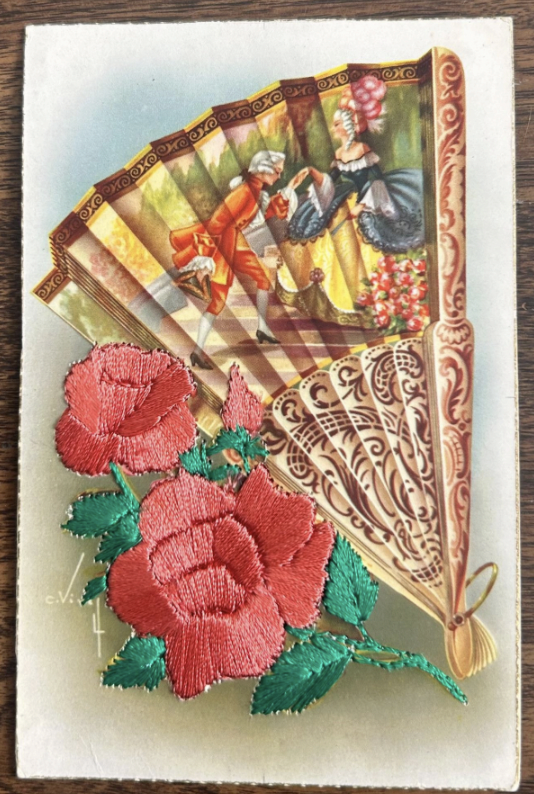
Produced in Spain, this postcard was never posted, but instead kept as a keepsake or memento. The postcard boldly mixes both media and art style. The printed background of the card shows a fan with intricately carved wood and its body displaying a Rococo-inspired scene of lovers courting one another. The bold and brilliant-colored embroidery stands in sharp juxtaposition, making the postcard feel unexpectedly modern. Other cards of this same make similarly featured a fan in the background, always with a classical scene of lovers or courtesans.

Mother’s Day Card, 1950s:

Mother’s Day Card, 1950s

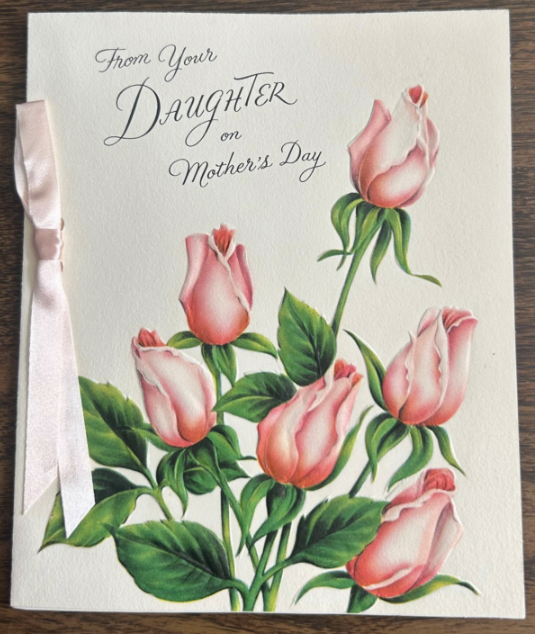
As a more modern example, it is only right that the greeting cards for the month of May include a Mother’s Day card! The Volland Company made cards from 1908-1959, including this one featuring bright pink tulips and tied with a pale pink ribbon. The simple design, from the detailed flowers to the script font on the front of the card, feels closely reminiscent of modern day greeting cards. Inside of the card is a poem, the end of which reads “You grow more like your Mother every single day.”

*

Every month, the Wellesley Historical Society highlights an object from its collection. These objects capture Wellesley stories, both those well-known to us and those yet uncovered. Historic artifacts symbolize and convey important narratives, whether that is the hard-working craftsman behind a piece or a written document that shaped the town’s future. As such, the Wellesley Historical Society collections capture the entirety of Wellesley as a town, from significant happenings to sentimental mementos.

Filed Under: History, Wellesley Historical Society Object of the Month

Tip us off…

Please send tips, photos, ideas to theswellesleyreport@gmail.com

Please support your local online news source with a tax-deductible donation by scanning the QR code
or by clicking on it.

QR Code

Advertisements

Wellesley Square Merchants
Wellesley, Jesamondo
Fay School, Southborough
Sexton test prep, Wellesley
Wellesley Theatre Project
Prepped and Polished
Perdocere, Wellesley
Wellesley HIlls Dental
Admit Fit, Wellesley
entering-swellesley-1
  • Bluesky
  • Facebook
  • Instagram
  • Twitter

Subscribe to our free weekday email newsletter

* indicates required

Follow Swellesley on Google News Showcase

The Swellesley Report has been selected to be highlighted on Google News Showcase. Please follow us there.

Most Read Posts

  • Bat Walk on Aug. 26th, sponsored by Wellesley Conservation Land Trust
  • Wellesley pays tribute to loooongtime DPW employee Smitty Rogers ahead of his retirement
  • Incoming: Teams rooms set to arrive at Wellesley High track and field this week
  • Wellesley High School drops to #35 in latest U.S. News rankings: What the numbers mean & how the community is reacting
  • With Solidcore and Degree Wellness on way to Wellesley, fitness vs. pastries arms race intensifies

Click on Entering Natick sign to read our Natick Report

Entering Natick road sign

Recent Comments

  • Bruce S. Pierce on Wellesley pays tribute to loooongtime DPW employee Smitty Rogers ahead of his retirement
  • Stevo Berg on Wellesley Police Dept. ends Flock license plate reader trial early amidst ‘overwhelmingly’ changed landscape
  • Joe Smith on Wellesley High School drops to #35 in latest U.S. News rankings: What the numbers mean & how the community is reacting
  • Nora Tracy Phillips on Wellesley High School drops to #35 in latest U.S. News rankings: What the numbers mean & how the community is reacting
  • Barry Braunstein on Wellesley High School drops to #35 in latest U.S. News rankings: What the numbers mean & how the community is reacting

Calendar

Upcoming Wellesley events

Upcoming Events

Aug 28
12:00 pm - 5:00 pm

Longfellow Wellesley Blood Drive

Aug 29
1:00 pm - 3:00 pm

Beyond Wellesley—Musical Matinee: The Band Wagon at Weston Newton Cinema

Sep 7
All day

Labor Day

Sep 8
7:00 pm - 8:30 pm

Welcome to the Graveyard (Wellesley library program)

Sep 10
7:00 pm - 8:00 pm

Wellesley Free Library presentation: “Massachusetts: The Library State”

View Calendar

Links we like

  • Danny's Place
  • Great Runs
  • Tech-Tamer
  • Universal Hub
  • Wellesley Sports Discussion Facebook Group

© 2026 The Swellesley Report
Site by Tech-Tamer · Login