Representatives from Jumbo Capital, which has entered into an agreement for the 888 Worcester St. office complex in Wellesley and an increasing number of other commercial properties in town, said the real estate investment firm is looking to build a senior living project at the Rte. 9 east spot. The roughly 6-acre property at 888 Worcester is currently home away from home for some town employees who were in on this past Monday’s Planning Board meeting, where Jumbo officials and an attorney representing the firm spoke (see Wellesley Media recording of Sept. 29 meeting).
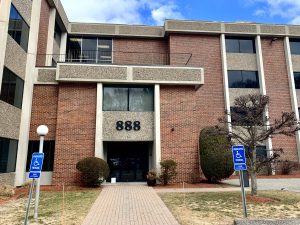
We first posted in June about the possibility of a senior living development coming to the site, which has served as a temporary Town Hall location and currently is home to the Planning Department, Health Department, and more. Planning Director Eric Arbeene said town officials began speaking with Jumbo months ago, but timed the public introduction of possible plans to the fall when more people are back in town. Jumbo reps said they are readying to reach out to neighbors.
“This represents a significant investment in Wellesley,” said Peter Tamm, a Goulston & Storrs attorney representing Jumbo. Tamm has made the rounds in town in the past related to real estate projects at the Wellesley Park site that’s home to The Nines apartments (we reached out to Tamm for an update on Wellesley Park, by the way, and will report separately on that area if there’s anything new).
Wellesley is headed for a huge redevelopment transition, with underused office space and older commercial space changing hands. Jumbo is just the latest entity proposing a housing development in town, with others envisioned for Oakland Street, Walnut Street, and 192-194 Worcester St. Often cited during project proposals or reviews are the town and state’s housing shortage, and recommendations in Wellesley’s emerging Strategic Housing Plan for more diverse housing stock.
Tom Powers, director of acquisitions for Jumbo, said there would be no conceptual plans to show yet, as the real estate development, management, and investment firm is in the feedback gathering stage about the future of the dated office property. The property sits next to the Boston Sports Institute at 900 Worcester St., and contains about 70,000 sq. ft. of office space across two buildings.
Love having a dedicated Wellesley news source? You can now make tax deductible contributions to support our work.
A challenge for Jumbo will be getting town approval to amend zoning for the property, which mainly occupies Administrative & Professional Districts. Town Meeting would need to approve any change, and then a project would need to navigate the usual maze of town department and board sign-offs.
“Some flexibility is going to be necessary to redevelop this site,” Tamm said.
Jumbo’s Sam Weissman, director of development, described a possible facility that would include independent living, assisted living, and memory care with proximity to amenities such as the town’s trail network. A facility is pictured that would include an indoor pool, a salon, and other features. The site could accommodate a project similar in some ways to Waterstone in lower falls, though larger.
Planning Board members said the project could be an improvement on the current site, which is heavy on parking and light on usable outdoor space. Jim Roberti expressed support for Jumbo’s direction, though warned that going the residential incentive overlay (RIO) zoning route would best be avoided in light of some recent failed attempts (Tamm confirmed RIO would not be the team’s direction). Roberti also noted that neighbors raised concerns about the height of the sports complex next door when it was being conceived, so that Jumbo should be aware of that.
The Board’s Patty Mallett and Kathleen Woodward agreed with these points, and said they felt optimistic that the town might support such a project given the desire for more senior options. Chair Marc Charney said: “This site is an example of where development and redevelopment fits…”
The Jumbo team said they’re looking to address issues like traffic, fiscal impact, and sustainability ahead of bringing anything to Town Meeting, whichever Town Meeting that might be, and will be reaching out to neighbors—as well as other town bodies and departments—in coming weeks (We welcome neighbors to pass along any Jumbo communications to us to help us keep the entire community informed).
Please send tips, photos, ideas to theswellesleyreport@gmail.com





It feels like the town is under assault with every area of the town battling a proposal.
To be clear, not everyone in town is “battling” these proposals. In my view, each one is a fantastic opportunity to expand the diversity of our housing stock to better accommodate the needs of seniors, young families, service workers, and people of moderate incomes.
I suggest readers become acquainted with your Pioneer Institute White Paper entitled:”Inclusionary Zoning in Massachusetts: A Solution to Exclusion or Short -Sighted Delusion? ” The Recommendations and Conclusion section is quite telling.
Please elaborate, Kim. I’m quite proud of my work on that paper. The title may be a bit gimmicky, but the substance is grounded in decades of academic insights and the most reliable data I could find.
Your title was not gimmicky but rather provided an honest portrayal of inclusionary zoning concerns and it was preferable to a blanket “fantastic opportunity” summation. Your paper stated the following: “The debate over inclusionary zoning’s merits reflects a tension between the urgent, short-term needs of many low income households to find affordable, secure living arrangements and the long-term desire to stabilize market home prices for everyone. Inclusionary zoning helps address urgent short- term housing needs for a few families, but can also jeopardize long-term, broad-based affordability by discouraging new supply and necessitating increases in markets rate prices to offset monetary losses from income restricted units.”
I see. I misinterpreted the point of your original comment, Kim.
Still, I stand by my original “fantastic opportunity” framing. First of all, the MassBay development is not subject to the inclusionary zoning bylaw. And the fact that the remainder of these projects have been proposed by private developers is a good indication that they are at least potentially financially viable regardless of Wellesley’s inclusionary zoning bylaw. It’s really the projects that are never proposed that I worry about with mandatory inclusionary zoning – could they have been viable without IZ? Perhaps…