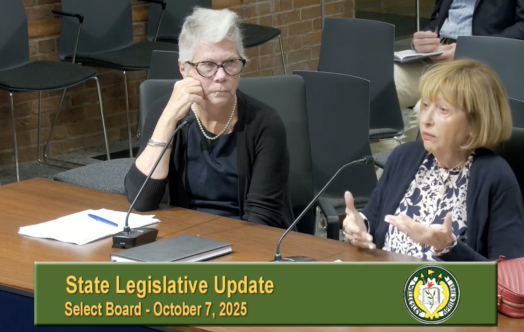
State Sen. Cynthia Stone Creem and State Rep. Alice Hanlon Peisch shared legislative updates with the Wellesley Select Board on Oct. 7, and heard from board members about the latest from the town as well (see Wellesley Media recording, about 7 minutes and 30 seconds in). Rep. Peisch got right into it, by speaking about the state and MassBay Community College plan to sell land for housing development and to help fund college campus initiatives.
Based on a state plan to allow a minimum of four units per acre to be developed, the town could be looking at least at a future 180-unit project in a part of town where residents say congestion is already awful.
Now, thanks to Swellesley’s partnership with Tiny News Collective, you can make tax deductible contributions to support our work.
The legislators recently had “a very productive meeting” with leaders and staff from the state’s Executive Office of Housing and Livable Communities and Division of Capital Asset Management and Maintenance (aka, state’s realtor), Rep. Peisch said. “They were very interested in what the community as a whole thinks,” she said.
The EOHLC and DCAMM teams said they were interested in public input about topics such as what type of housing is needed (retirement, workforce, etc.), and how open space fits in. The more specifics, the better, Rep. Peisch said.
The purpose of the meeting from the legislators’ perspective was to get information from the state agencies about some of the board’s and public’s concerns, including the murky timeline.
“The number one message we got from them is that this is a housing project,” Rep. Peisch relayed. They were not open to putting this project aside to look at other ways to help the college achieve its funding needs, she said.
Board Chair Marjorie Freiman said she found it encouraging that the agencies told the legislators that they want to hear from the town, as the town seeks to do some “visioning” by early December to inform requests for proposals sent to developers.
According to Peisch, there’s no set timeline to issue RFPs, as the state agencies understand it could take months to come to agreement on what would be included in them. She said there had been some confusion about an RFP going out in 30 days, and that is not the case.
Sen. Creem said there could be a trade-off between protecting some or all of the 40 acres of forest within the MassBay property, and the height of whatever structure or structures are built. But she did get the impression 180 units was the magic number for the state, so that the town shouldn’t negotiate for higher density in exchange for other wants.
Working with a consultant, the town might want to give the public a sense of the different options and trade-offs that could be on the table so that they can better visualize possible outcomes, Freiman said.
Other unanswered questions at this point relate to traffic and parking. If the current lot across Oakland Street from the MassBay campus has housing developed on it, MassBay will need more parking for its students and staff elsewhere, and that could impact traffic. How upgrades to the nearby intersections would be funded is another challenge that board member Colette Aufranc raised during the discussion.
Moving on to other issues, Sen. Creem raised the topic of state funding in light of rapid fire federal moves.
Passage of the One Big Beautiful Bill Act in July has big implications for the state, Sen. Creem said. “The tax change in the federal law had a spillover into Massachusetts to the tune of $650 million,” she said, pointing to the frequent coupling of the federal and state tax codes in areas such as the state and local tax (SALT) deduction cap, which was raised significantly. The state didn’t know the federal changes would be coming before the state set its budget that started in July. The state gave itself a cushion in the budget, but there are still unknowns, such as on healthcare costs. Money has been coming into the state via taxes at a higher rate than a year ago, but not high enough to fill gaps, Sen. Creem said.
Earmarks, those targeted appropriations that state legislators get for their constituents, are also on hold pending what the governor does later this year (see also “Select Board meeting brims with positive financial news”).
Despite the discouraging funding news for the state, Rep. Peisch said she’s an optimist by nature and is hopeful that funding information will become clearer in weeks and months ahead so that state and municipalities can make needed decisions.
Other updates included one on an act to allow print-free legal notices, including in publications like ours. Rep. Peisch said that had a favorable committee report, but that in addition to a Wellesley home rule petition, Peisch filed a bill that would have implications beyond Wellesley since many communities want this flexibility, and that may be the direction in which the legislature heads.
A town effort for property tax deferrals for senior heads to a hearing in early November, and Rep. Peisch anticipates action on that soon.
Regarding a bill about the individual Medicare Marketplace that Wellesley Retirement Board Chair David Kornwitz promoted during this week’s All Board Meeting, Rep. Peisch said there is interest in the legislature but also strong opposition from a group that represents state retirees. She said more organized support, such as from the Massachusetts Municipal Association and a critical mass of municipalities, is needed to boost the bill. Wellesley town leaders have expressed their support for this bill in light of the national health care cost crisis.
Related: Legislators share updates with Select Board on climate, public meetings, more (Janary, 2025)
Multi-family housing developments in the works in Wellesley




I agree with Barbara Donovan that 180 is not a real number. 4 units per acre is “by right” and lifts the zoning almost completely out of Wellesley’s hands. The implicit threat is that, in the most adversarial process, the state can sell off the entire property to the highest bidder, which would have the right to clear the whole forest and build exactly 4 units per acre. The town will obviously do nearly anything to avoid this. The document that Andrew Mikula pointed to (https://www.mass.gov/doc/affordable-homes-act-section-122-surplus-land-guidance/download) invites towns to negotiate “binding development agreements” prior to the competitive selection process for developers. But DCAMM holds all the chips. A binding development agreement can’t impose “discretionary decisions on an as-of-right use”, which means that the town can’t have subjective requirements, such as that the building be “aesthetically pleasing.” (Page 4).
I’m not involved in real estate development, but if Wellesley wants to have more power for subjective approval after DCAMM sells the property, it will need to offer some inducement to the developer – perhaps additional, profit-making, market-rate units.
Senator Creem is being a savvy politician by representing the 180 number as firm. It encourages everyone to make peace with the process the state allows. But, just for right now, I’m not ready to pretend I like this.
I would love to see the state commit to only 180 units but I have concerns that is not a real number
What do you mean by “not a real number”? It’s the minimum number the town has to allow to be built under state law. Four units per acre. See https://www.mass.gov/doc/affordable-homes-act-section-122-surplus-land-guidance/download (towards the bottom of page 2).
Many proponents of the state’s sale of MBCC land east of Oakland St. to build at least 180 units talk about the project as if it is neutral on the environment because all units could potentially go on a 5-acre subsection of the 45-acre parcel that presently serves as a parking lot. What is missing from these discussions is that at least this many acres of parking capacity will need to be situated east of Oakland on the side of the present-day campus, and this acreage could very well come at the expense of a large forested area there, unless overground parking structure(s) are built to replace the existing, significantly (3-5X) reducing the overall footprint.
If a very large surface-level parking lot is built in the most trivial location aboveground/upstream a residential area, 5-acres of forest and natural habitat will be lost and even with good practical stormwater capture and treatment (MassDEP), pollutants such as oil, grease, PAHs, heavy-metals, de-icing/chloride, and microplastics will reach downstream residents backyards and basements, to say nothing about the remainder of the forested land downstream and its natural habitat.
My hope is that the state will act to protect the environment, habitat, and residents on campus-side by building above-ground parking garage(s) that while costlier, carry many additional benefits including protection from inclement weather, quicker exit to Rt-9, and ease of deploying EV charging and solar generation.
I don’t envision MassBay building new surface parking lots anytime soon. The ones they already have in Wellesley are incredibly underutilized. That’s why they allowed the Town to build makeshift pickleball courts on one of them earlier this year: https://theswellesleyreport.com/2025/04/wellesleys-newest-pickleball-courts-at-massbay-parking-lot/.
Also, MassBay’s full-time enrollment dropped by 35% between 2012 and 2023: https://datausa.io/profile/university/massachusetts-bay-community-college#enrollment. I’m pretty sure that includes all of their campuses, but still – there are good reasons to think they’ll be just fine without replacing the parking one-for-one.
More broadly, people need to live somewhere, so consider the alternative locations for building housing. Is it better for the environment to build it in Wellesley or Hopkinton (the fastest-growing town in Greater Boston in the 2010s; see https://donahue.umass.edu/business-groups/economic-public-policy-research/massachusetts-population-estimates-program/census-2020-data-for-massachusetts)? Building in Wellesley means better transit access and shorter commutes for most households.
I drive by MBCC on Oakland St almost every day and often see that the 5-acre parking lot is practically full. For a long time, MBCC has been lending its parking lot to the motorcycle training school during off-peak hours. The same logic applies to pickleball courts.
When it comes to infra planning, you plan closer to the peak demand, not average. Furthermore, you would plan for demand years out, so you would know where to place your other assets and reserve buildable capacity for future expansion. So even if MBCC students require close to 5 acres of parking now occasionally, you cannot have less than this many stalls of parking capacity, however they are delivered.
MBCC total enrollment has increased to 4,590 in ’24 from 3,973 in ‘23. I could not readily find ’25 data, but https://www.massbay.edu/about indicates that around 6K students are now served. MBCC enrollment varies significantly in relation to employment and other indicators, increasing significantly during recessions. There are expected to be large employment shocks due to uptake of AI, which will undoubtedly increase MBCC enrollment.
If the project were to proceed as discussed, replacing parking capacity on the side of the campus will need to be the 1st step. If cost savings were of highest priority, 5 acres of woodland would be lost due to parking in addition to 2-3 acres due to expansion of athletic facilities to include regulation soccer and T&F, which will take up 4-5 acres.
Sure. Perhaps Mass Bay should explain how it plans to accommodate future parking demand, but the idea that it will need to tear down forests to do so is empty speculation. Where is the evidence that replacing the parking by “tearing down 5 acres of woodland” is necessary?
It’s true that planning to peak demand is standard practice for parking, but it’s also an immensely flawed practice. Parking lots that are only full for a few days a year are wasting space. That may or may not be the situation at MassBay now, but in the future it’s worth considering alternatives like demand management and pricing. After all, charging students more for parking would be way more cost effective for MassBay than building more parking. Might save some woodlands too, eh?
Also, in bringing up the need to model out future demand, you assume that future travel demand will mostly be fulfilled by cars. That’s a self-fulfilling prophecy. Building parking to accommodate “future cars” incentivizes more people to drive.
I cited the full-time enrollment figures for a reason. It’s hard to know how often the part-time students are actually on campus, and we still don’t know what the breakdown is between campuses. The overall enrollment trend from 2012-2024 is still down, and “students served” is probably not apples-to-apples with enrollees.
Again, you’re assuming way too much when you say “if cost savings were of highest priority, 5 acres of woodland would be lost…”
Mass Bay full-time enrollment increased from ’23 to ’24, from 1,335 to 1,437. Because overall enrollment increased at least 16-20% further in ’25, it is reasonable to expect that full-time enrollment would increase in tandem. Part-time students at MBCC average just under 7 credits per semester, compared to 14-15 credits for full-time enrollees. Thus, with a total # of students around 6K, part-timers take as many courses or more in aggregate than full-timers and their #s should be counted as well.
If enrollment was not projected to increase or at least stay constant, the reasoning for $75M cyber-security center expansion (or overall expansion) would be less sound.
When it comes to the location of parking at MBCC, one needs to study topography, what is already there, and what is planned. MBCC has not completed a traffic study yet, but if you look at what is there and where natural elevation changes, a flatter nearby portion to the South-East will already be taken up by 4-5 acres of regulation soccer plus T&F. Looking outside this space, there is a student lawn to the East of campus that will likely be preserved. The remaining present unpaved area is mostly trees.
It would make a lot of sense for the State/MBCC to develop necessary parking capacity as parking structures closer to Rt-9, which are largely insensitive to elevation, in line with administration’s sustainability (solar gen + EV charging) and environmental goals, which would benefit all stakeholders.
Okay. Let’s back up for a second.
Your argument, as I understand it, is essentially this: “Building housing on the west side of Oakland Street is a bad idea because that will force MassBay to destroy woodlands elsewhere on campus to replace the parking.” Correct?
In retrospect, the idea that 1) declining enrollment through 2023 and 2) the town establishing pickleball courts on the same parking lot last spring are indicators that MassBay probably doesn’t need the parking was flawed.
But you still have presented no real evidence that MassBay will have to destroy woodlands to build more parking, or even that it will have to build more parking at all. Rather, your argument assumes from the get-go that rising enrollment means rising parking demand and that demand can’t be managed or accommodated in any other way besides adding more spaces. Has any representative of MassBay actually said that the college will need more parking if the west lot is developed? If so, has any representative of MassBay said they would rule out the idea of a more sustainable parking structure closer to Route 9?
Or is this just another “what if” excuse for why we can’t build more housing in Wellesley?