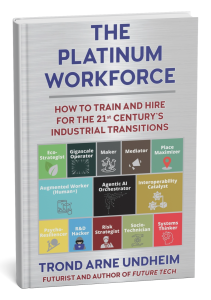
 Wellesley author Trond Arne Undheim, who as a researcher is always looking to the future, has released his eighth book, “The Platinum Workforce.”
We met recently in town to discuss the book, which follows other thought-provoking reads such as 2023’s “Eco Tech” and 2020’s “Pandemic Aftermath.”
After Stanford and MIT research, Undheim has identified core and complementary skills that he says will shape career success as AI and emerging technology reshapes work. We dove into some of the details…
What does “The Platinum Workforce” mean?
Think of it like the metal: rare, durable, catalytic. But instead of sitting in a vault, these workers do what AI still can’t: navigate messy problems, connect ideas across fields, and make good decisions when the rules don’t exist yet.
The core message is simple: build human capability first, then add AI. When people skip the foundation—when ChatGPT does everything—their own skills start to slip. I call it “capability drift.” It’s that moment when you’re not sure whether the AI is right or confidently hallucinating.
If your kid is heading to college, they don’t need one more coding bootcamp. They need skills that don’t expire—systems thinking, interdisciplinary communication, the ability to stitch together people, data, and technology. AI becomes a force multiplier only after you’ve built that base.
You said society knows almost nothing about running $20B+ gigascale projects. What projects do you mean, and why does it matter?
Boston learned this the hard way. The Big Dig started at $2.8B in 1982, ended at $24B with interest—a megaproject that morphed into a gigaproject and shaped the region’s budget for decades.
Now these enormous projects are everywhere: California high-speed rail ($106–135B projected), semiconductor fabs, space programs, climate infrastructure. Historically, think the Panama Canal or the Interstate Highway System—same DNA, different era.
Here’s the Wellesley angle: a surprising number of residents already work at this scale. Finance folks managing multi-billion-dollar portfolios. Biotech leaders running huge R&D pipelines. Developers behind billion-dollar real estate projects. Federal officials navigating DC budgets that make your head spin.
And frankly? This is where the excitement is. This is where society’s biggest challenges get solved—and where the compensation reflects that scale. We’re talking about work with genuine upside, both intellectually and financially. If I’m advising Wellesley families about career paths, I’d say: don’t shy away from gigascale. This is where your kids should aim—it’s important work, it pays well, and it matters.
The problem is we don’t teach people how to operate in that environment. A 22-year-old engineer can make a billion-dollar mistake—or catch a billion-dollar insight. Gigascale work magnifies both brilliance and failure. Our schools haven’t caught up.
You wrote this book for kids entering college, but also for parents and employers. What do you hope they get out of it?
This book is deeply personal. I wrote it thinking about my daughter Naya (a Babson freshman, studying in London this semester), my son Jax (16, building his own AI startup), and Zadie—who’s already using Snapchat’s AI to guide decisions in her private life, even though it’s still outlawed in school. That gap between what kids are actually doing and what schools acknowledge tells you everything about where we are with AI integration.
For students: majors matter, but not as much as capabilities. The book lays out 13 future-proof skills—from systems thinking to R&D fluency to coordinating human-AI teams. These are what employers truly hire for, even if they don’t always articulate it well.
For parents: when your kid tells you, “ChatGPT does my homework,” the key question isn’t “Is AI good or bad?” It’s “Do they have the foundation to use it wisely?” Sequence matters.
For employers: hiring based on degrees is breaking down. Skills now depreciate faster than diplomas. The book provides a practical skills taxonomy and hiring framework for a world where job requirements change faster than HR can update the posting.
Where is AI having its most positive and negative impacts right now?
Positive: AI is a superpower in medicine (diagnostics), materials science (battery and semiconductor breakthroughs), and software (automating repetitive coding). It lets humans focus on judgment, creativity, and strategic decisions.
Negative:
- Capability drift: Students and professionals lose the ability to check the AI’s work.
- Equity gaps: The best tools sit behind paywalls. I needed paid versions of Gemini and Claude while writing this book just to get reliable output—and I worry about what that means for schools.
- Verification burden: AI produces confident nonsense. Much of my writing time went to fact-checking beautifully phrased errors.
AI is excellent at structure, data, and summaries. But matching voice, style, or deep reasoning? Still early innings. But I have advice on that, too.
How should schools integrate AI?
Slow down on teaching “prompt engineering.” Speed up on teaching foundational capability.
Kids need hands-on problem solving—starting ventures, coordinating human-machine workflows, tackling environmental and engineering challenges, practicing systems thinking. Then AI becomes a partner rather than a shortcut.
They also need exposure to risk far earlier. More young professionals now enter roles where mistakes can have billion-dollar consequences—energy grids, climate systems, critical infrastructure. Our curriculum doesn’t match the scale of the responsibility we hand them.
Above all, teach metacognition—the skill of choosing what to learn and how to adapt. That stays valuable long after today’s tools are obsolete.
The reality is that AI policies need to constantly evolve—what made sense last year is already outdated. I’d love to consult with local schools and colleges on developing adaptive AI policies that actually match how students live and learn, rather than policies that kids just work around.
Talk about your use of AI in writing and marketing the book.
I used AI extensively, but never as a ghostwriter. The core thesis and the 13 skills came from decades of work. AI helped me pressure-test chapters, generate scenarios, and tighten language.
I used several models—Gemini, Claude, ChatGPT, Copilot, Llama, Deepseek—and asked them to challenge each other. They disagreed constantly, which revealed blind spots and reduced hallucinations. (Deepseek often just told me it was “busy”—a very human moment from a machine.)
But AI also doubled my revision time. It mixes flashes of brilliance with confident errors, and it doesn’t cite where it borrows ideas from. You need strong underlying judgment to manage that.
For me, AI expanded my thinking—while making the process messier. That’s the Human+ era.
Beyond AI, what other big shifts should workers pay attention to?
Gigascale operations: Projects that routinely exceed $1B—and often $20B+. Everyone eventually interacts with work at this scale, even if indirectly. And again—this is where the action is. This is where careers get built, where problems that matter get solved, where compensation reflects impact.
Cascading risks: Climate, cyber, supply chains, geopolitics—they now stack and amplify each other. Workers need tools to spot early warning signs and operate under constant volatility.
Interoperability mindset: Modern work requires translating between people, disciplines, technologies, and organizations. The future belongs to connectors.
Together, these trends define the Platinum Workforce.
How long did this book take?
Two years of concentrated effort, built on 30 years of research—from MIT Startup Exchange to Stanford CISAC.
The Stanford commute became part of the story: Tuesday dawn flights from Boston, long research days, Thursday red-eyes home. I did that for two years. The Sahai Family Foundation made the work possible; coffee and Norwegian stubbornness made it survivable.
But the big insight from that period was clear: skills—not technology—determine whether we adapt or stumble when systems break.
Anything else to cover?
The book moves from diagnosis (why systems are breaking) to capability (what skills we need) to practice (how to teach them). It’s meant to be action-oriented.
My Norwegian-American background—from serving as National Expert on e-Government at the European Commission to MIT to Stanford—gives me a cross-Atlantic view of how different societies respond to disruption. It informs every chapter.
More about the author and book:
“The Platinum Workforce” can be found at Wellesley Books (“My first choice—please support our indie stores.”) and other independent bookstores can order it. It’s also available at online booksellers.
Undheim is looking to do local author events, and says he’s happy to speak with local schools, book clubs, or parent networks about AI, careers, and education choices.
The author can be reached on LinkedIn and via email. “I love hearing how people are navigating this new AI-driven world,” he says.
Please support your local online news source with a tax-deductible donation by scanning the QR code or by clicking on it.