• Sign up for free email newsletter
  • Advertise
  • Donate to support our work
  • Events calendar
  • About Us
DAF
 
Pinnacle, Elaine Bannigan
 
Wellesley Hills Dental

The Swellesley Report

Since 2005: More than you really want to know about Wellesley, Mass.

  • Restaurants, sponsored by black & blue
  • Camps, sponsored by NEOC
  • Wellesley Square
  • Private Schools, sponsored by Prepped and Polished
  • Public Schools, sponsored by Sexton
  • Preschools, sponsored by Longfellow, Wellesley
  • School news
  • Kid stuff
  • Top 10 things to do
  • Business news
  • Worship
  • Letters to the editor
  • Guidelines for letters to the editor
  • Live gov’t meetings
  • Sports schedules & results
  • Deland, Gibson’s Athlete of the Week
  • Deaths
  • Housing
  • Medical providers—sponsored by FIXT Dental
 

Top Stories

Wellesley imagines what North 40 can do for community going forward
Maugus Cafe reopening; plans for dinner service
Single-family home sales

Advertisements

Needham Bank, Wellesley
FIXT
Down Under, Wellesley

Public Notice

early voting october 2026
 

Flag Day in Wellesley is June 14th

June 9, 2026 by admin

Wellesley will hold its annual Flag Day event on Sunday, June 14 at 1 p.m. at Woodlawn Cemetery (148 Brook Street).

This is an annual ceremony to retire and appropriately dispose of worn and tattered American flags. Flag Day has been celebrated as a patriotic occasion since 1916.

dressing of graves woodlawn cemetery
Woodlawn Cemetery, Brook St.

Worn or no longer usable flags may be dropped off this week at the following locations in Wellesley:

  • Town Hall West Lobby (525 Washington Street)
  • Council on Aging entrance (500 Washington Street)
  • Wellesley Recycling and Disposal Facility (RDF) at the clothing & textiles recycling area

To allow time for collection, all flags must be dropped off by Thursday, June 11.

Filed Under: History, Holidays


Advertisements

black & blue, Wellesley
Olive Tree Medical, Wellesley
Haskins Automotive, Wellesley
MIT Museum, Cambridge
June 2026: Object of the Month

Examples from the Wellesley Historical Society fan collection

June 1, 2026 by Morgan Stevenson-Swadling

As spring blooms into summer, it is only appropriate that we take a look at one of the most beautiful, intricate, and popular ways of staying cool from over 100 years ago — the handheld fan!

Since their invention, handheld fans have been a coveted accessory of high society. Their designs and materials shifted with fashion and social trends, yet they consistently remained objects of artistry and elegance. Folding fans appeared in Europe in the late 16th century, and by the 18th century, they had become so popular that both men and women carried them.

These graceful accessories, often crafted of ivory, lace, or silk, also conveyed meaning through a “language of the fan.” A flick of the wrist or subtle twirl could signal interest, intrigue, or dismissal, all without a word being spoken. Beyond their social utility, fans stood as symbols of refinement, affluence, and style, remaining fashionable well into the mid-20th century.

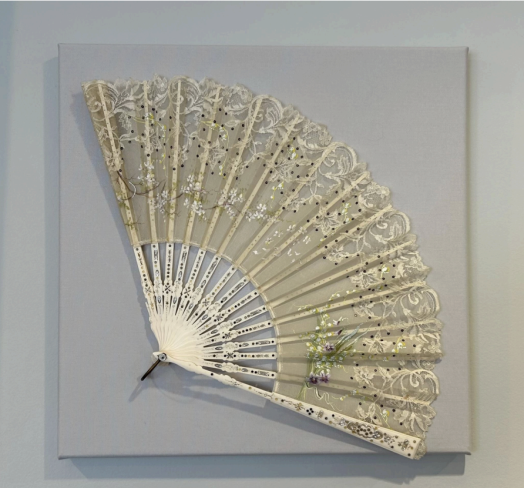
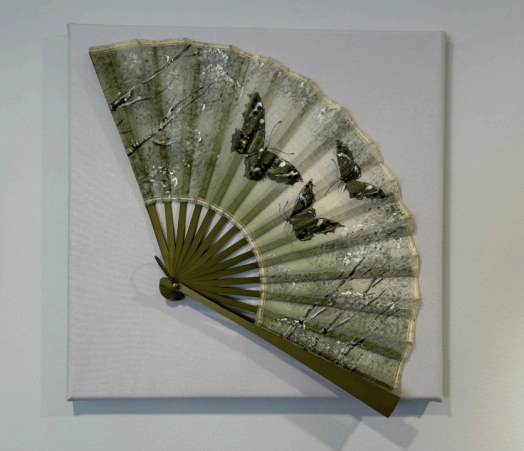
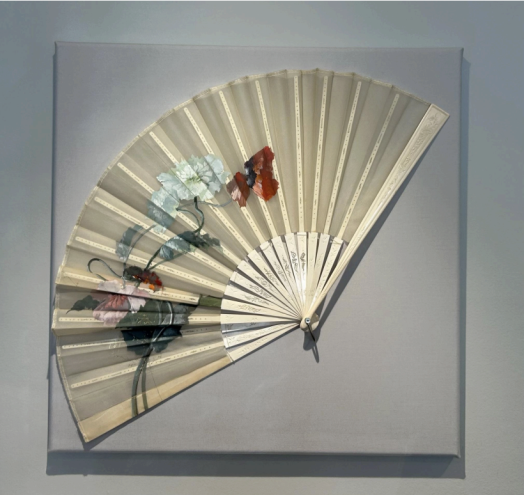
These examples date from the late 19th century. As Victorian fashions introduced larger bustles and more voluminous gowns, fan sizes expanded to match. Their slim, lightweight sticks — typically made of ivory or wood — supported leaves of gauze, lace, or silk, often painted with naturalistic designs such as flowers, birds, or butterflies, and occasionally enhanced with glittering steel or silver spangles. Over the span of 10 years, these late Victorian fans have both similarities in their designs and differences as aesthetic interests changed and evolved.

Painted Lace Fan, 1875

Lace sits on delicately carved ivory sticks for this stunning fan from 1875. Finely decorated with purple blooms and sprigs of bluebells, the painted elements interact with and play with the floral patterns woven into the lace itself. Additionally dotted with small silver decorations, this fan is a fascinating study of using multiple techniques to beautify an object with a largely “practical” purpose.

Green Silk Fan Hand-Painted
Green Silk Fan Hand-Painted with Butterflies, 1882

Green silk and painted wood craft the body of this fan, hand-painted with nature motifs and butterflies. In the late Victorian era, butterflies were a popular symbol, particularly for jewelry and accessories. The butterfly was believed to represent the soul, and was a source of Victorian fascination due to its metamorphosis, thought to be comparable to human growth and transformation. The butterfly was also used frequently in Japanese art, another Victorian interest. While the butterfly held symbolic weight and intrigue, we can also understand it as an aesthetic and fashionable motif: one can picture the butterflies on this fan “moving” through the air as the fan was waved back and forth!

Fan with Hand-Painted Floral Motif, 1885:
Fan with Hand-Painted Floral Motif, 1885

This 1885 fan is constructed of hand-painted lisse displayed on finely carved ivory sticks. The fan’s bones are intricately carved, but the fabric itself is kept simple except for the vibrant burst of flowers stretching across the fan’s body. Though the fan dates before the Art Nouveau style developed and took hold, the long lines, asymmetrical design, and Japanese-inspired flowers are all deeply reminiscent of the style.

The Wellesley Historical Society hosts a vast collection of accessories, dating from the late 18th-century until now. These three fans, along with several others, are currently on display in our exhibition Wellesley Through Time, up through June 17th, 2026. Stop by for a last chance visit!

Every month, the Wellesley Historical Society highlights an object from its collection. These objects capture Wellesley stories, both those well-known to us and those yet uncovered. Historic artifacts symbolize and convey important narratives, whether that is the hard-working craftsman behind a piece or a written document that shaped the town’s future. As such, the Wellesley Historical Society collections capture the entirety of Wellesley as a town, from significant happenings to sentimental mementos.

More: Past Object of the Month posts


Sign up for Swellesley’s free weekday email newsletter

Filed Under: History, Wellesley Historical Society Object of the Month

Page Waterman, Natick
London Harness, Wellesley
Dedham Country Day School
Wellesley Wonderful Weekend

British Infantrymen love Wellesley Bakery, too

May 17, 2026 by admin

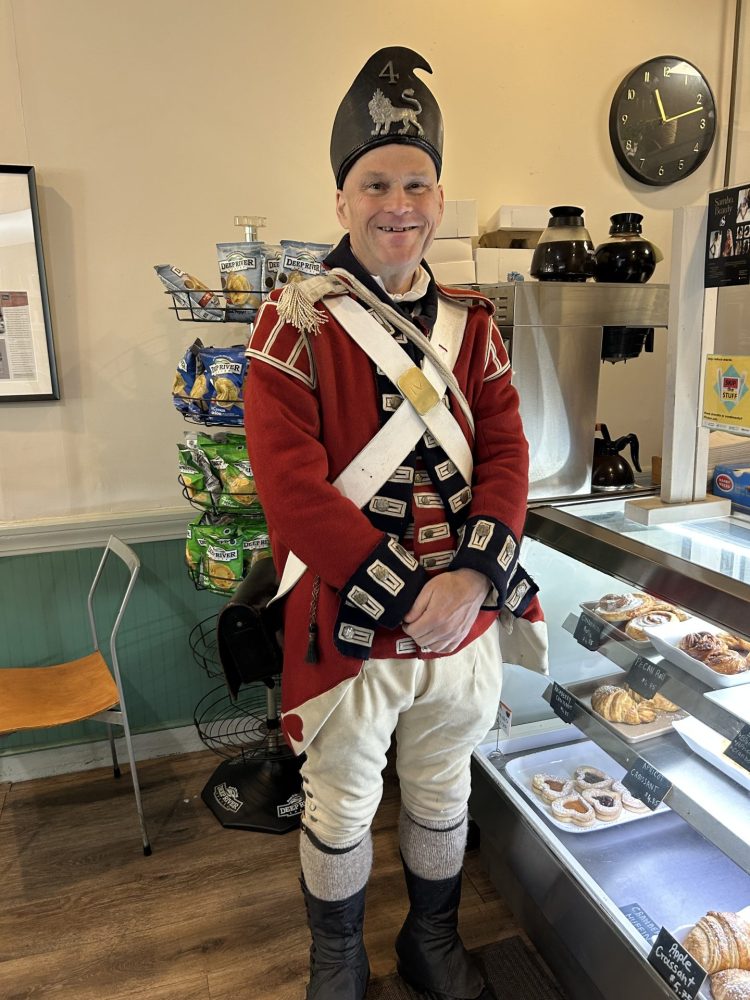
From Swellesley reader Kathryn Alexander: “Just snapped a photo of this soldier (Andy) picking up lunch at Wellesley Bakery prior to the reenactment of Paul Revere’s capture!”

soldier at bakery
Photo courtesy of Kathryn Alexander

 
The reenactment took place at Wellesley Town Hall as part of Wellesley Wonderful Weekend, which celebrated the USA’s 250th birthday.


See something? Send something: theswellesleyreport@gmail.com

Filed Under: History, Wellesley Wonderful Weekend

Wellesley Youth Basketball
Longfellow, Wellesley

Wellesley Wonderful Weekend—here’s the entire schedule

May 15, 2026 by admin

The town of Wellesley is preparing for one of its most anticipated traditions as the Celebrations Committee gears up for Wellesley Wonderful Weekend. This year’s festivities are set to be particularly historic, as the community gathers to celebrate the 250th birthday of the United States.

And so much more

The major events include the Veteran’s Parade, followed by the Town picnic, concert, and fireworks, on Sunday, May 17. In addition, there’s plenty to do  over the whole weekend including checking out historical displays; open houses all over town (police, fire, MLP, and more); the Schofield 5k Wonder Run; Rotary Club of Wellesley’s Pups in the Park event; and so much more.

Here’s the schedule—don’t miss a thing! For a larger-print version, please go to https://wellesleywonderfulweekend.com/schedule-2/

Saturday, May 16

Saturday-Sunday
Encampment Display — 18th century military equipment, Royal Irish Artillery
Morton Park Field, 485 Washington St.

7 a.m.Charles Link Trail Thru-Hike
Guided long-distance hike led by Scout Troop 185.
8 a.m.–NoonPancake Festival at Wellesley High School
Wellesley Kiwanis Club and Wellesley Key Club.
50 Rice St.
9 a.m.–1 p.m.Kids Crafts, Free Vision Screening and Eyeglass Collection
Wellesley Lions Club.
Linden Square Plaza, 180 Linden St.
9 a.m.–NoonTouch a Truck
Department of Public Works, 20 Municipal Way (off Route 9).
11 a.m.–Noon sensory hour, no honking.
9 a.m.–1 p.m.Open House at Wellesley Municipal Light Plant
4 Municipal Way (off Route 9).
9 a.m.–1 p.m.Open House at Wellesley Main Fire Station #2
457 Worcester St.
10 a.m.–11:15 a.m.Guided Walk — Hemlock Gorge (1 mile)
Explore trails and bridge along the scenic historic Charles River.
Meet at Echo Bridge Office Park parking lot, 381 Elliot St., Newton.
10 a.m.–NoonOpen House at Wellesley Police Station
485 Washington St.
10 a.m.–2 p.m.Open House at Wellesley History & Exhibit Center
Wellesley Historical Society, 323 Washington St.
10 a.m.–2 p.m.Tollhouse Shop Sale
Wellesley Historical Society, 229 Washington St.
Noon–2 p.m.Open House at Wellesley Council on Aging
Tolles Parsons Center, 500 Washington St.
1 p.m.–2 p.m.Join famous ventriloquist Paul Revere
Interactive performance explaining Paul Revere’s ride and drafting of the Declaration of Independence.
Town Hall, 525 Washington St.
2 p.m.–3 p.m.Front Lines of Valley Forge, General George Washington
Presented by Family Descendants.
Town Hall, 525 Washington St.
1 p.m.–3 p.m.Build Your Own: Nancy’s Troll and Fairy House Event
At Pickle Point on Morses Pond.
Parking area opposite 49 Russell Rd.
3:30 p.m.–6 p.m.Pups in the Park
Hunnwell Field.
4 p.m.Veterans Ecumenical Memorial Mass at Saint Paul Church
Organized by Wellesley Veterans Council.
502 Washington St.

Sunday, May 17

8 a.m.Wonder Run 5K Race and Kids Fun Run
Certified family 5K road race followed by Kids Fun Run and activities/prizes.
Wellesley High School Track, 50 Rice St.
8 a.m.–10 a.m.Guided Bird Walk at Morses Pond
Hosted by Wellesley Conservation Land Trust.
Meet at Morses Pond gate.
8 a.m.–12:30 p.m.Antique Car Show “Wheels of Wellesley XIII”
Central Street.
1 p.m.–3 p.m.58th Annual Wellesley Veterans Parade
2026 theme: 250th Anniversary of the Birth of America.
Route from Wellesley Community Center to Wellesley Square.
4:30 p.m.–DuskPicnic and Concerts in the Park at Hunnwell Field
Food, rides, crafts, games, ponies and more.
Concerts by the Wellesley Town Band and The Reminisants, plus theatrical performance by The Wellesley Theatre Project.
DuskFireworks
At Hunnwell Field.

Wednesday, May 20

6:30 p.m.–9 p.m.Taste of Wellesley
Rotary Club of Wellesley.
Wellesley Country Club.
Charity event featuring local restaurants, cafes and caterers.

These events have passed:

[Read more…]

Filed Under: Community, Entertainment, History, Wellesley Wonderful Weekend

Wellesley Symphony Orchestra
Wellesley Marketplace 2026
May 2026: Object of the Month

Greeting Cards from the Wellesley Historical Society Collections

May 6, 2026 by Morgan Stevenson-Swadling

The “golden age” of greeting cards spanned from the late Victorian period into the Edwardian period. In the mid-19th century, greeting cards and postcards became more accessible and affordable due to improvements in printing technology. As sending and receiving postcards became more commonplace, their design grew to become more elaborate, with elements such as lace, fabric, and gilting emerging as trends.

Greeting cards and postcards are a fascinating example of how we have communicated across time. Their featured art and design can also tell a larger story of popular symbols, motifs, and cultural interest in a given time period. For May’s object of the month, we take a look at four greeting cards from the Wellesley Historical Society’s archives.

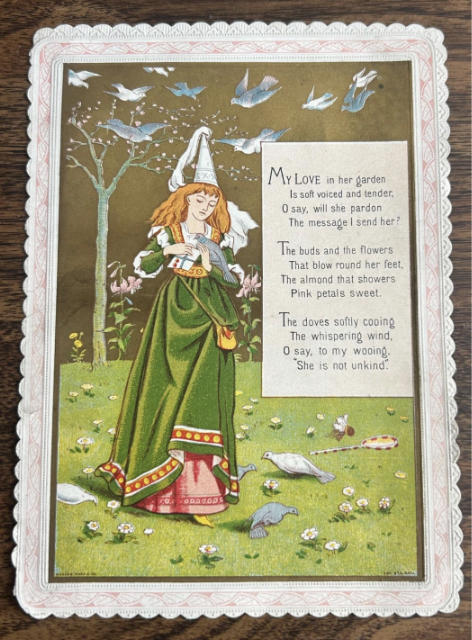
Valentine’s Day Card, Late Victorian Period:

Valentine’s Day Card, Late Victorian Period:
Photos from Wellesley Historical Society

.
This storybook-esque Valentine’s Day card was produced by Marcus Ward & Co., an Irish publishing company active from 1833 to 1899 that was known for its illustrated books for children and adults. Marcus Ward & Co. began producing cards from the late 1860s onward to massive success, employing famous and beloved children’s book illustrator Kate Greenaway. Marcus Ward & Co. cards have been preserved in museums across the world, notably the V&A Museum in London.

This lace-trimmed card features a maiden in medieval garb, a dove and a love letter, implied to have just been received from a suitor, settled within her arms. The card leans into nature motifs as comparison to blossoming affection, with flowers budding along the bare tree in the background and blooms appearing in the grass. The picturesque image is accompanied by a poem, in which the suitor is reassured by the doves that his paramour’s heart is not unkind to him.

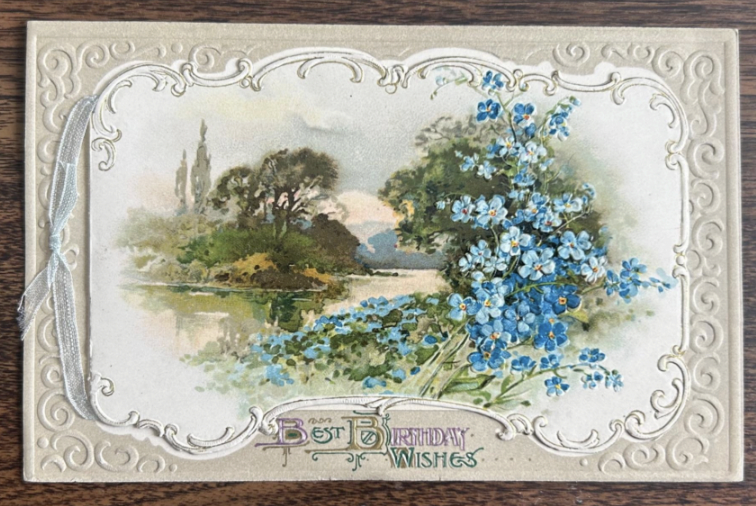
Birthday Card, 1911:

Birthday Card, 1911

This spring-like birthday card was sent to a Miss Agnes Goddard for her birthday on December 3rd, 1911. The card is bound with a thin pale blue ribbon, and its edges are embossed. The card can be opened to a message within, but there is a traditional divided back postcard on the back as well.

The card is adorned with a burst of bright blue forget-me-nots before a wider landscape scene. Forget-me-nots were an immensely popular motif in the Edwardian era, symbolizing true love, friendship, and remembrance. They appear on several other cards in the Wellesley Historical Society collection. Edwardian birthday cards also often featured a short poem or fragment of a poem.

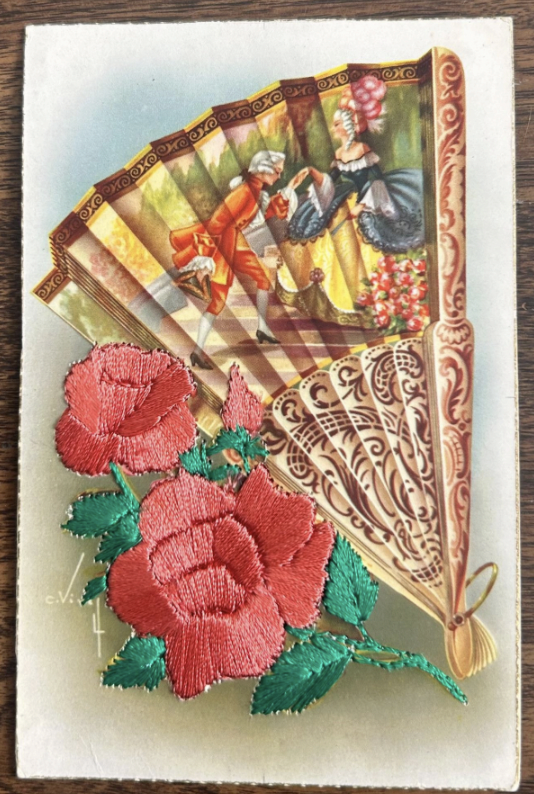
Embroidered Postcard, Edwardian Era:

Embroidered Postcard, Edwardian Era

Produced in Spain, this postcard was never posted, but instead kept as a keepsake or memento. The postcard boldly mixes both media and art style. The printed background of the card shows a fan with intricately carved wood and its body displaying a Rococo-inspired scene of lovers courting one another. The bold and brilliant-colored embroidery stands in sharp juxtaposition, making the postcard feel unexpectedly modern. Other cards of this same make similarly featured a fan in the background, always with a classical scene of lovers or courtesans.

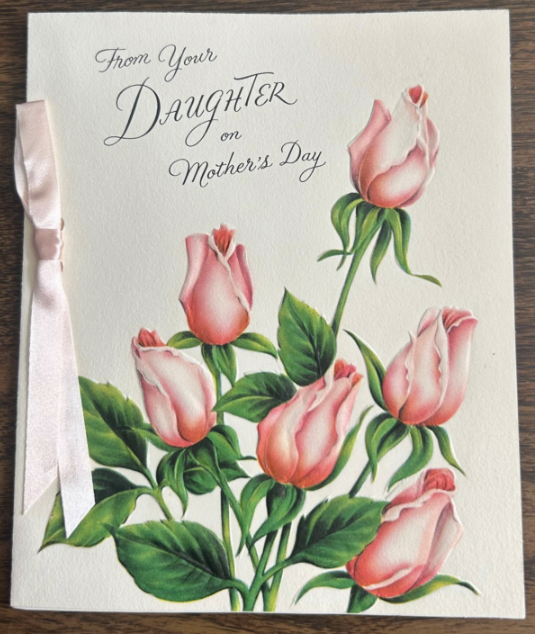
Mother’s Day Card, 1950s:

Mother’s Day Card, 1950s

As a more modern example, it is only right that the greeting cards for the month of May include a Mother’s Day card! The Volland Company made cards from 1908-1959, including this one featuring bright pink tulips and tied with a pale pink ribbon. The simple design, from the detailed flowers to the script font on the front of the card, feels closely reminiscent of modern day greeting cards. Inside of the card is a poem, the end of which reads “You grow more like your Mother every single day.”

*

Every month, the Wellesley Historical Society highlights an object from its collection. These objects capture Wellesley stories, both those well-known to us and those yet uncovered. Historic artifacts symbolize and convey important narratives, whether that is the hard-working craftsman behind a piece or a written document that shaped the town’s future. As such, the Wellesley Historical Society collections capture the entirety of Wellesley as a town, from significant happenings to sentimental mementos.

Filed Under: History, Wellesley Historical Society Object of the Month

Wellesley, Health Dept., Menopause movie

Wellesley College’s historic Clapp Library moves into its next chapter

April 28, 2026 by Deborah Brown

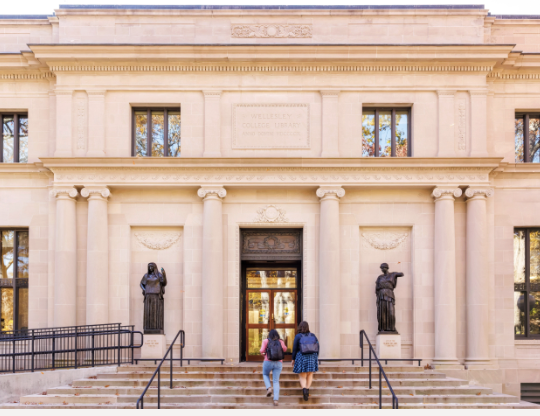
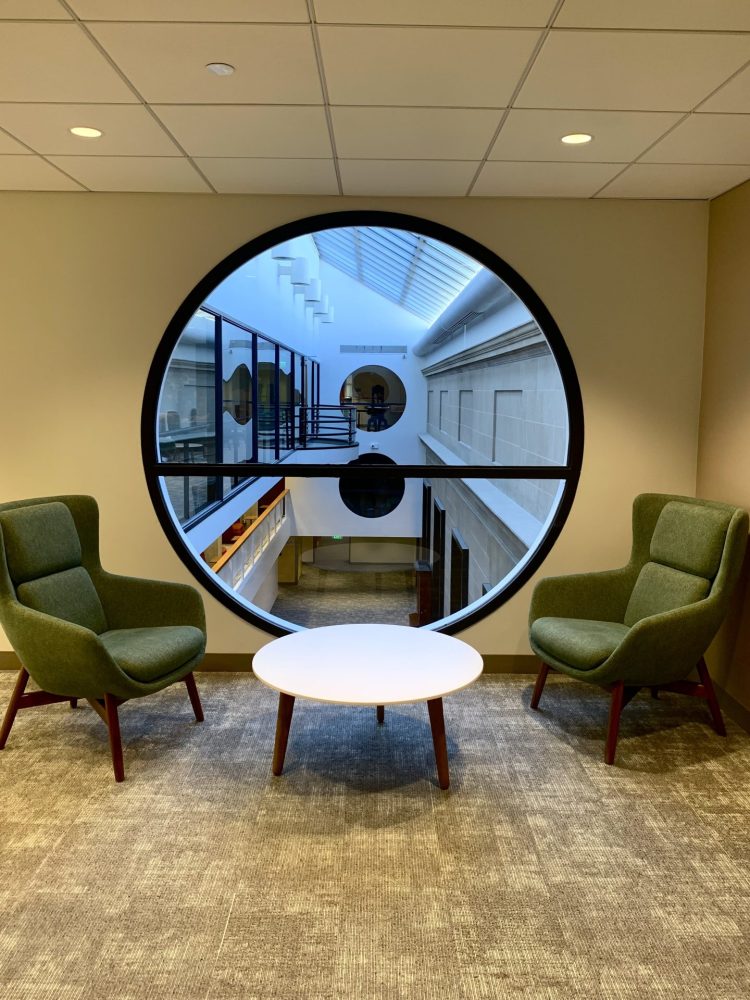
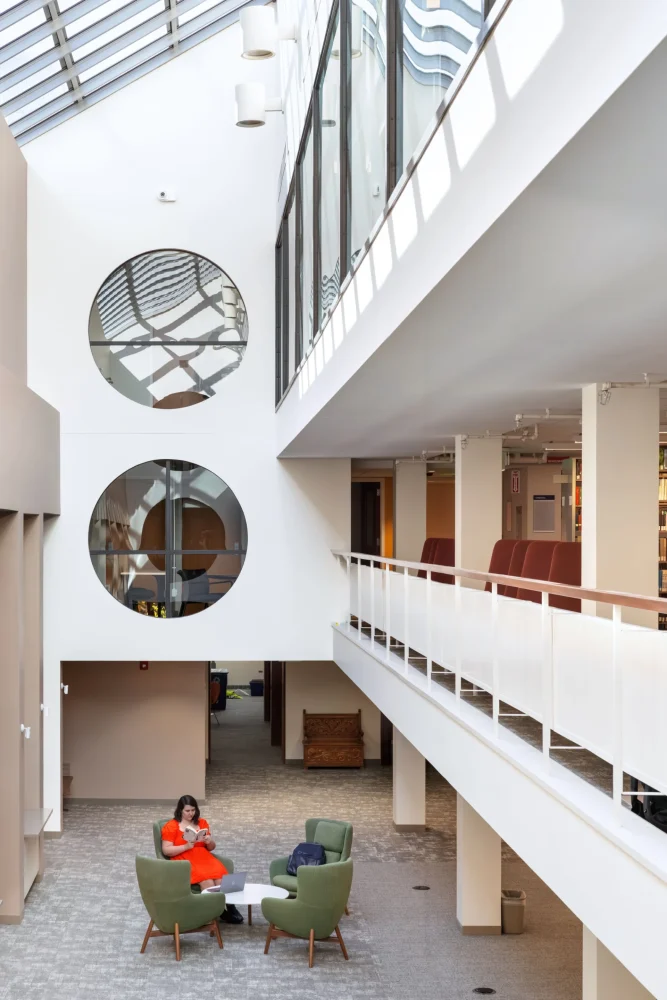
For over a century, the Clapp Library at Wellesley College has stood as the intellectual heart of Wellesley College. But after an ambitious 18-month renovation, the building has emerged, fresh from library staff is calling “a complete glow up.” Reopening its doors this past September, the 180,000-square-foot facility now blends its historic 1910 roots with the needs of the 21st-century student.

Wellesley College, Clapp Library
The original 1910 façade still serves as the primary entrance to the building. Photo via Shepley Bulfinch

The original plan was for modest, low-key updates to address deferred maintenance. As with most renovations of historic buildings—the thoughtfully designed ones, anyway—a lick and a promise wasn’t going to cut it. The project quickly morphed into a full-building intervention as the project team realized the library required the kind of transformation that meets modern needs—and must conform to modern rules. So many building code requirements. So much for a low-key, easy-peasy reno job.

Alexis Veigas, Clapp’s Office and Building Manager and Jenifer Bartle, Director of Library Collections took time out of their day to show me around a renewed space of which they’re rightfully quite proud.

Boston-based Shepley Bulfinch was the architectural firm chosen for the job. The Boston-based company has over 100 years of history with the College. The original library building was designed by Shepley, Rutan and Coolidge and opened in 1910. Two subsequent additions were designed by Shepley, Bulfinch, Richardson and Abbott, opening in 1959 and 1975, respectively.

Walking into the refreshed lobby, visitors are immediately greeted by a vibe that is both welcoming and professional. Student-staffed kiosks and a redesigned service desk anchor the main entrance which, for the first time, is wheelchair accessible. In fact, the whole building now features new accessibility features. All four floors of shelving are now wheelchair accessible, and the building was designed to support both neuro- and physical diversity.

Wellesley College, Clapp Library
Wellesley College, Clapp Library service desk area.

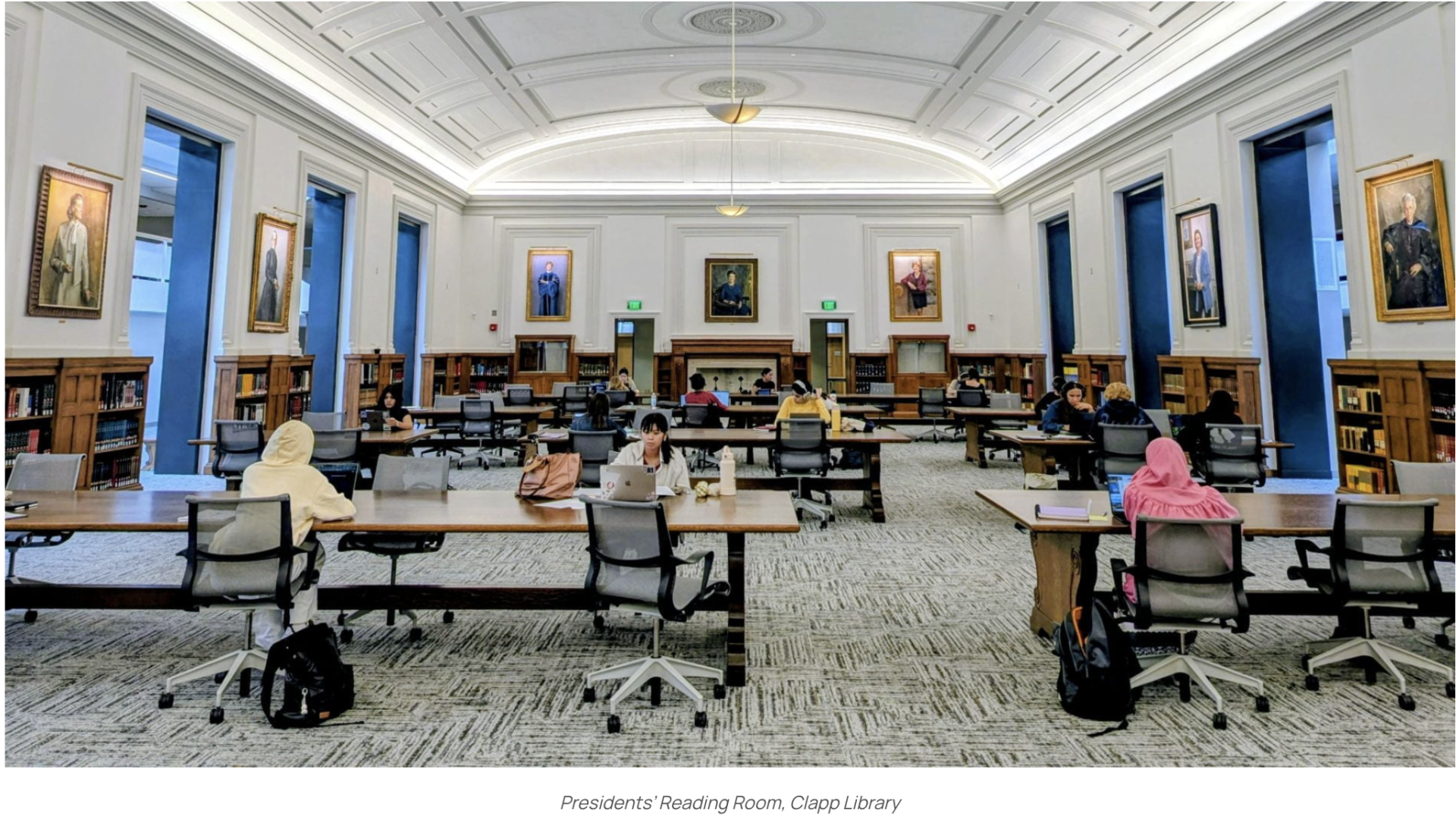
The jewel in the Clapp Library crown has always been the Presidents’ Reading Room. But over the years, some hodge-podge elements had infiltrated. After consulting historical photographs, the team tracked down and returned original study tables that had been dispersed throughout the building over decades.

“This space is one of my wow factors for sure,” said Jenifer Bartle, Director of Library Collections.

Wellesley College, Clapp Library
Photo via Wellesley Collge.

The room now features new chandeliers—replacing outdated, “big-box store” fixtures—along with lighting that highlights the portraits of Wellesley’s 14 presidents dating back to 1875. Bookshelf-lined walls give the space a classic reading room feel while modern comforts were added. Those original study tables are as cool as they were 100 years ago, but the vintage straight-backed wooden chairs—not so much. So new chairs were tested by students and staff for comfort, promptly replacing the old back-breakers.

History has been preserved, but modern technology certainly was not left behind. The new Knapp Makerspace and Multimedia Center has been added, equipped with fabrication tools and high-end creative software. A new equipment check-out desk allows students to more efficiently borrow Chromebooks, laptops, and professional media gear like cameras and audio recorders.

Wellesley College, Clapp Library

Wellesley College, Clapp Library
Everywhere possible the team created open spaces to allow more light in. Photo by Shepley Bulfinch

The much-anticipated cafe opened last month, because who wants to venture outside for a bite to eat during a marathon study session?  When we were there, the cafe and lounge area looked like it had been discovered. Although the cafe won’t be staffed all 20 hours per day the library is open to students, there is a vending area for those late-night nosh needs. While the wider Wellesley community is welcome from 9am to 4pm to the library or the cafe, the Clapp Library is truly a student space.

Generous alumna comes through

The renovation was made possible through the generous support of Trustee Emerita Lia Gelin Poorvu ’56 and her husband, Bill. Their contribution allowed the college to go beyond surface-level repairs and address critical, “invisible” infrastructure including new HVAC systems, two new elevators, and fresh paint and carpeting throughout, along with enhanced humidity and temperature controls to protect the archives and special collections—and, as Bartle noted, “our people too.”

Sustainability was also at the forefront of the new design. Green features include all-electric HVAC systems and energy efficient lighting. Ignoring the siren call of teardown/rebuild, and instead reusing the existing structure to minimize new embodied carbon, was another key move that also kept as many materials as possible out of the landfill.

A flexible future

Flexibility, adaptability, and student-facing were the watchwords that informed every feature of the design. With a couple hundred additional seats added to the footprint (which, by the way, remained intact), Clapp Library is ready for the future. The design philosophy centered on flexibility and adaptability. Rooms that serve as faculty-student consultation areas during the day easily transition into student-led group spaces on evenings and weekends.

“We needed flexibility in space, and flexibility in how the spaces are used over time,” Bartle said. As the college moves forward, Clapp Library stands as a testament to the idea that a historic building can evolve, providing a light-filled sanctuary for generations of students to come.

Filed Under: Construction, History, Wellesley College

Advertisement

maverick ad sept
History

Reflecting on the Wellesley Inn’s demolition 20 years ago

April 7, 2026 by Emma Mullay

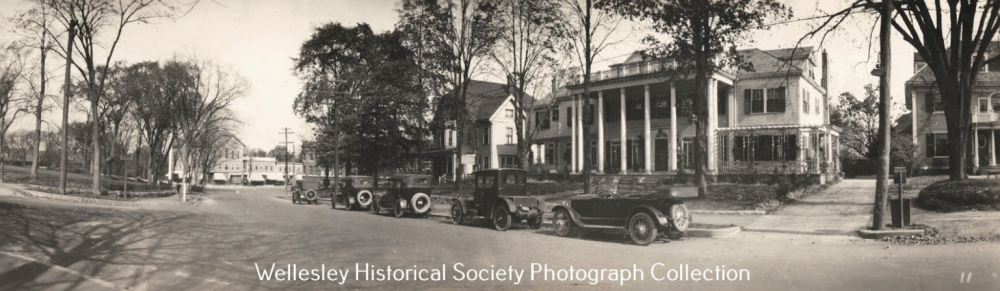
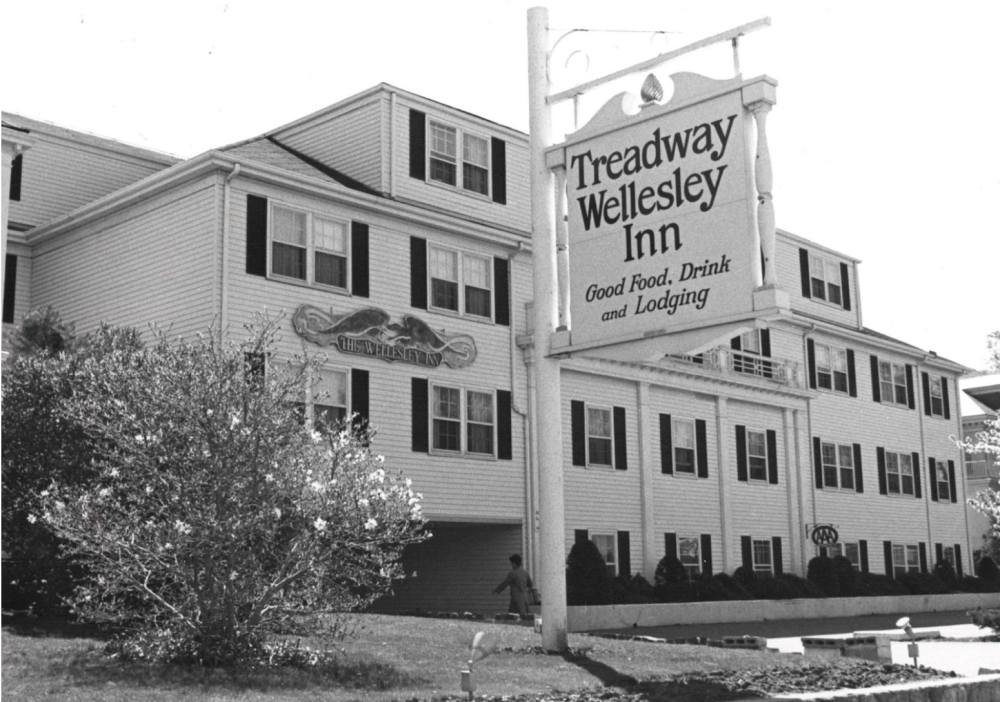
Wellesley Inn (Wellesley Historical Society Photograph Collection)

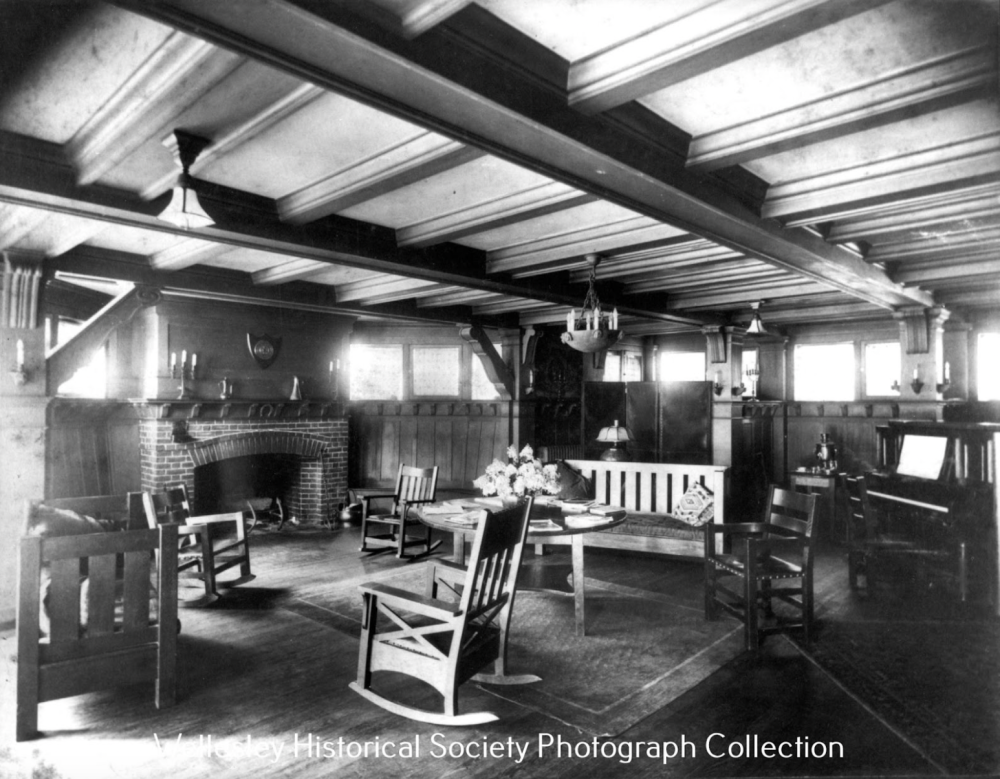
The first room to the left in the Wellesley Inn housed a large, ornate fireplace, a central part of the living room where residents would meet up to chat or solve jigsaw puzzles over tea and corn muffins. The room was adorned with dark and moody wooden accents, and community members would gather in one of the Inn’s three unique dining rooms, or by the rocking chairs on the front porch looking out over Washington Street. It was a place to eat, a place to meet, and a place to simply get together with friends and family. 

But that was 20 years ago. 

Now, in its stead, stands a luxury condo development with over 20 housing units above the businesses on the lower level. Gone are the days of the historic community gathering hub that held that lot for over a century, now home to a modern monolith, and to some, a shadow over the town. 

Long-time Wellesley residents, like Beth Hinchliffe, mourn the loss of the Inn and what it stood for. Originally the Wellesley Tea Room, it was established in 1897 and remained the focal point of the town until it was sold to developers and demolished in 2006. 

“It was really important in the life of the town, because it had grown up with the town,” Hinchliffe said. “It had a graciousness about it, and an awareness of history, of where we came from. It was a connection with all the generations that have come before.”

Hinchliffe said she attended all sorts of events at the Inn throughout the years, from baby showers to wedding receptions to graduation and birthday parties. But above all, she said, it was a place for the community to come together, and one that hasn’t been replicated since. With three different restaurants — a tavern, a ballroom, and the original tea room — there was something for every occasion. 

“It led to losing the sense of a town center, a community center, because it really was our community gathering place,” Hinchliffe said. “It was so much a part of all your life.” 

Wellesley Inn (Wellesley Historical Society Photograph Collection)
Inside the Wellesley Inn (Wellesley Historical Society Photograph Collection)

She recalled going there after graduation to celebrate and how her parents went out to dinner there every year for Mothers’ Day. There was caroling in the winter, Easter egg hunts in the spring, and it was where everyone gathered after the annual Wellesley Veterans Parade. Her favorite memories, however, were sitting by the fireplace in the living room with friends and family, drinking tea and solving puzzles in the warmth of the flame.  

“That room was like a big embrace,” she said. “I remember times I’d been out shopping with friends and we would just go in to get our tea in front of the fireplace.”

Katherine “Gig” Babson has lived in the same house in Wellesley for almost 79 years and remembers the Inn as “a glorious structure,” with the columns and stairs providing an intense visual impact in the heart of town. In her 50 years of involvement in local politics, she served as a Select Board member for nine years and was on the committee when the building was torn down. 

Babson said she has “very strong feelings” about the Inn being demolished instead of purchased by Wellesley College. 

“My unfiltered view is that Wellesley College had a great opportunity to purchase it and make it into a boutique hotel for the benefit of Wellesley College students,” she said. “I think it’s a missed opportunity.” 

At the time, there were movements from local residents to see if there was any way to preserve some part of the original building, but most people understood that it was incredibly expensive and would have been far too large of an undertaking to be feasible. 

Wellesley Inn (Wellesley Historical Society Photograph Collection)

Tory DeFazio, a resident of almost 89 years and a Town Meeting member for over 50, said that the Inn originated as a family home and eventually expanded to serve the parents of the students at Wellesley College looking for somewhere to stay. Since then, those families and anyone else visiting Wellesley have had to stay in nearby towns like Needham or Newton, he said. 

“When we had family weddings, the guests would stay there at the Wellesley Inn, and you could sit out on the front porch in a rocker and look at the traffic going by,” he said. “It was just a lovely environment, and they were always very gracious.” 

It has been 20 years since the demolition itself, which fell exactly on Wellesley’s 125th birthday on April 6, 2006. That decision, though likely unintentional, was a blow to many who were already devastated by the loss of the historic building, with Babson referring to the choice as “a huge booboo.” 

“If you’re going to take down something that a lot of people have strong feelings about, maybe you shouldn’t take it down on the town’s birthday,” she said. “They could have been more sensitive.”

Hinchliffe remembered the day itself, noting that while people knew the demolition was imminent, nobody expected them to pick that day to tear it down. Friends called to her to avoid the “heartache” of the demolition, and “the town really got riled up when they tore it down on exactly the 125th birthday.” 

“It was shocking to a lot of people,” DeFazio said. “It was gone before you knew it.” 

While there are some visual similarities between the Wellesley Inn and The Belclare, the new development that took its place, they serve vastly different functions.

“The columns are the only thing that remind me of the old Inn,” DeFazio said. “But there’s no porch, no rockers.” 

The Belclare
The Belclare (photo by Emma Mullay)

On the ground level of the development, there are a number of shops that are rented out, although there has been a significant amount of turnover with them, DeFazio said. Above them are the luxury condos, selling for up to $3 million. 

Lois Lee and Young Jo Kim, Wellesley residents of 22 years, didn’t live in town during the Inn’s prime and don’t remember it when “it was really being used.” 

“It’s nice for having the option of a luxury condo right in the center of town,” Lee said. “They did a beautiful job with the building, and it is nice to have the retail on the first floor.”

But while these condos provide a new life for the lot, others, like Hinchliffe, still deeply mourn that place it used to be. 

“I just loved it, and I miss it,” she said. “I think everybody misses it.” 

This story is part of a partnership between the Swellesley Report and the Boston University Department of Journalism.

Filed Under: History, Housing

Object of the Month

Wellesley Historical Society’s lithograph by Isaac Sprague IV reminds us of spring’s bloom

March 31, 2026 by Morgan Stevenson-Swadling

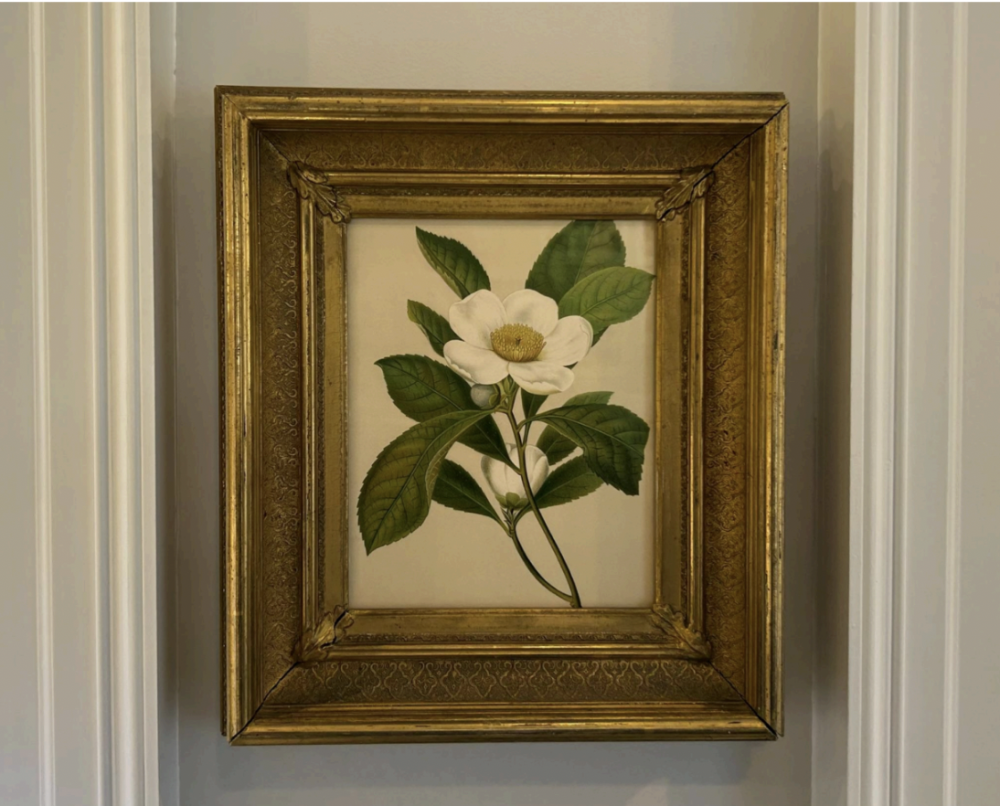
The White Bay (Gordonia Pubescens), By Isaac Sprague IV (1811-1895)Lithograph from “Flowers of the Field and Forest,” 1882
The White Bay (Gordonia Pubescens) by Isaac Sprague IV (1811-1895). Lithograph from “Flowers of the Field and Forest,” 1882

 
Sprague is a familiar name in Wellesley: one need only look to the iconic Sprague Memorial Clocktower or the Sprague Elementary School. Isaac Sprague V (1859-1934) was a town benefactor and a highly influential figure in Wellesley’s civic and cultural development, with a deep dedication to education and public access. Sprague served on many town committees and as Town Selectman. He was the president of the Wellesley Club from 1910-1912 and the first ever President of the Wellesley Historical Society, serving from 1925 until his death in 1934.

Influential in a very different capacity was Isaac Sprague IV (1811-1895), father of Wellesley’s beloved benefactor. The elder Sprague was a career artist and botanical illustrator. He famously worked alongside John James Audubon, accompanying him on an 1843 expedition up the Missouri River.

This lithograph depicting the White Bay flower was completed by Isaac Sprague IV and appeared in the 1882 book “Flowers of the Field and Forest,” a collection of Sprague’s watercolors juxtaposed with text penned by the Reverend A.B. Hervey. Also known as Gordinia, White Bay flowers are striking blooms with rounded white petals and a center of yellow stamens that grow forth from large shrubs native to Florida and Georgia.

Accompanying Sprague’s illustration was an excerpt from the William Cullen Bryant poem “Among the Trees,” a romantic exploration of the relationship between humans and nature. In Reverend Hervey’s note on the flower, he revered Sprague’s artistic ability and carefully observant eye, writing that “Mr. Sprague has reproduced the beauty and elegance of the flower so faithfully that I need not attempt a further description of it in words.”

The lithograph was donated by Albion Billings Clapp in 1958. Its frame is original to the donation, though we are not sure when exactly it was created. It has since been restored.

As April’s object of the month, the lithograph reminds us of spring’s bloom and is a pleasant and eye-catching representative of Sprague’s talent. However, the illustration also shows the importance of artists in disseminating scientific knowledge and study of our natural world. “Flowers of the Field and Forest” would have been used as an educational tool at the time of its publication. It is also a fascinating example of Victorian literature and study. The unusual combination of popular poetry, detailed scientific watercolors, and conversationally written scientific fact would be seen as odd in today’s publishing world, but perfectly common 150 years ago!


Every month, the Wellesley Historical Society highlights an object from its collection. These objects capture Wellesley stories, both those well-known to us and those yet uncovered. Historic artifacts symbolize and convey important narratives, whether that is the hard-working craftsman behind a piece or a written document that shaped the town’s future. As such, the Wellesley Historical Society collections capture the entirety of Wellesley as a town, from significant happenings to sentimental mementos.

Morgan Stevenson-Swadling is Director of Exhibits & Collections at Wellesley Historical Society.

Filed Under: Art, History

« Previous Page
Next Page »

Tip us off…

Please send tips, photos, ideas to theswellesleyreport@gmail.com

Please support your local online news source with a tax-deductible donation by scanning the QR code or by clicking on it.

QR Code

Advertisements

Wellesley Square Merchants
The Village Bank, Wellesley
Wellesley, Jesamondo
Fay School, Southborough
Sexton test prep, Wellesley
Wellesley Theatre Project
Prepped and Polished
Perdocere, Wellesley
Wellesley HIlls Dental
Admit Fit, Wellesley
entering-swellesley-1
  • Bluesky
  • Facebook
  • Instagram
  • Twitter

Subscribe to our free weekday email newsletter

* indicates required

Most Read Posts

  • Wellesley Halloween happenings—2026 edition
  • Friday is letters-to-the-editor day
  • Indigenous Peoples Day 2026 Wellesley—what’s open and closed, nearby events
  • Wellesley Service League Men’s Group Speaker Series to welcome Social Entrepreneur
  • Wellesley imagines what North 40 can do for community going forward

Click on Entering Natick sign to read our Natick Report

Entering Natick road sign

Recent Comments

  • Concerned Resident on Wellesley imagines what North 40 can do for community going forward
  • Ann Gagliano on Wellesley artist mashes up ‘Birth of Venus’ & Halloween
  • Select Board Should Listen (to some music) on Wellesley imagines what North 40 can do for community going forward
  • How is this affordable? on Wellesley All Board Meeting brings who’s who of town leaders together to look ahead
  • Gwen Baker on Wellesley School Committee extends superintendent’s contract, refines AC funding request

Upcoming Events

Oct 12
All day

Indigenous Peoples Day

Oct 12
1:00 pm - 3:00 pm

Learn to Play Rummikub

Oct 12
7:00 pm - 8:00 pm

Wellesley Choral Society rehearsals

Oct 14
6:30 pm - 8:00 pm

Wellesley Square Improvement Project public meeting

Oct 15
10:30 am - 1:30 pm

Friends of the Wellesley Council on Aging present Health & Wellness Fair

View Calendar

Links we like

  • Danny's Place
  • Great Runs
  • Tech-Tamer
  • Universal Hub
  • Wellesley Sports Discussion Facebook Group

© 2026 The Swellesley Report
Site by Tech-Tamer · Login