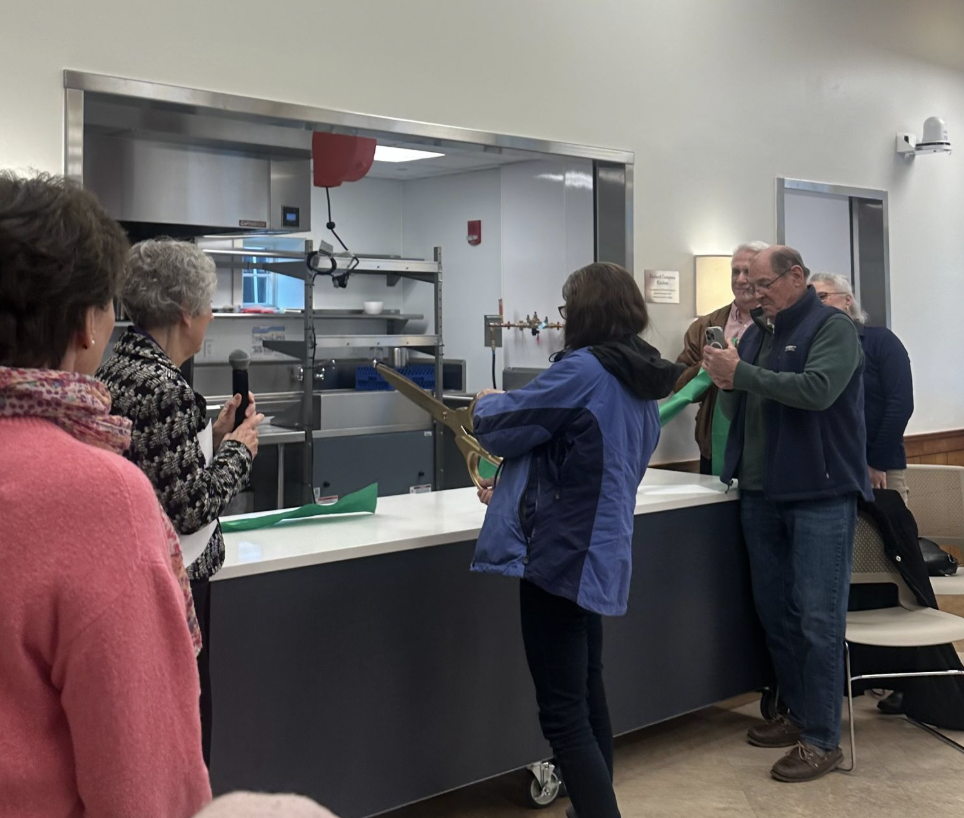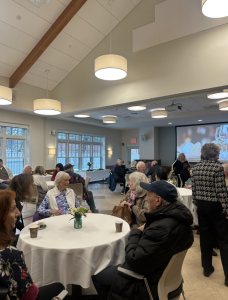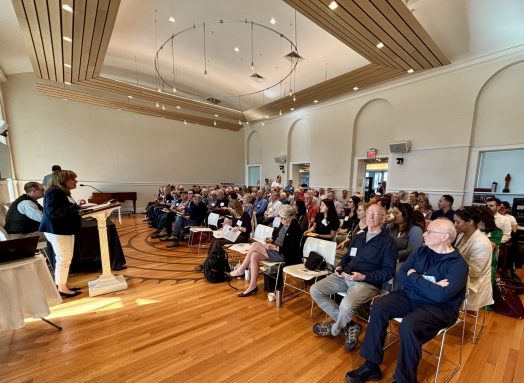
More than 150 participants packed into Wellesley Village Church earlier this spring for the town’s first Geothermal Forum, an event highlighting eco-friendly alternatives to traditional natural gas heating and cooling systems. The church showcased its new geothermal system while discussing the technology’s environmental benefits, overall cost breakdown, and potential in homes and commercial buildings.
The room quickly reached capacity, with every seat filled and a standing crowd lining the back of the hall. Organizers said the April 15 event drew a mix of Wellesley residents and people involved in commercial developments, large property owners, multiple colleges, multiple houses of worship, community leaders and more interested in learning about geothermal solutions.
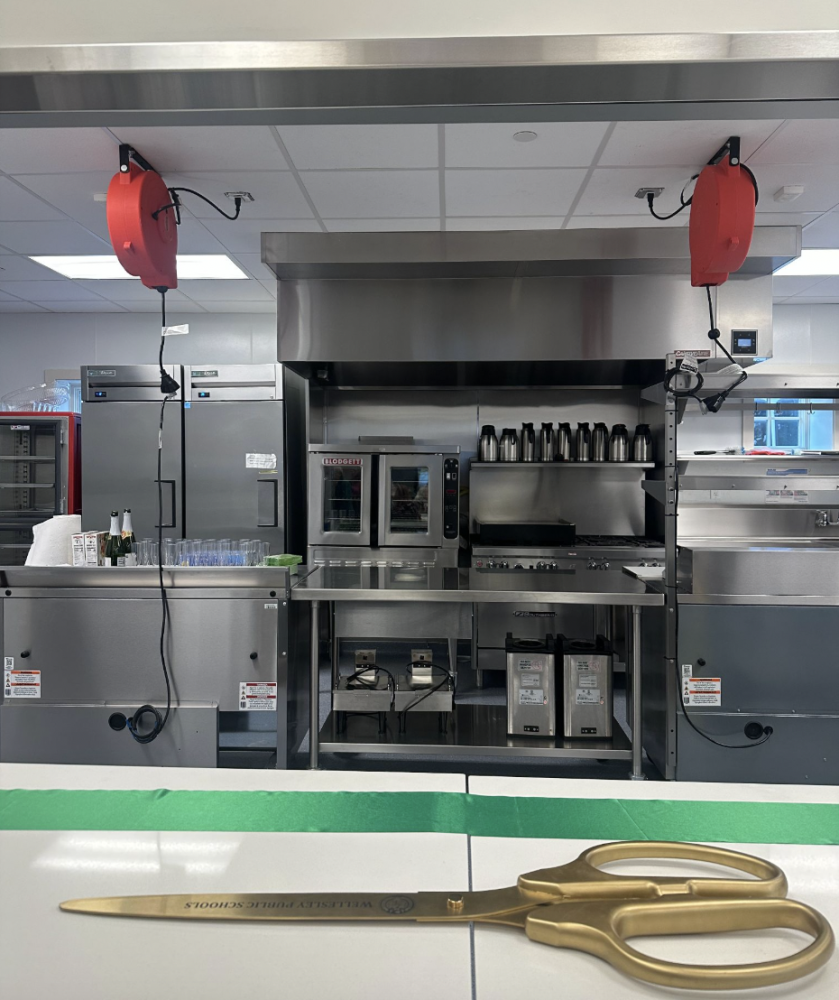
The Wellesley Climate Action Committee co-hosted the event with the Village Church. Reps from the church, which implemented its geothermal system in November, led guided tours in the basement, allowing attendees to take photographs and see the installation up close.
Geothermal energy utilizes heat energy from the earth to provide heating during cold times of the year and cooling during summer. This energy is accessed by bore holes and wells.
“We as a congregation have been so hopeful that this would be an example and that the installation would be informative and inspirational,” said Kathy Schleyer, co-chair of Empowering the Future and a community leader at the Village Church.
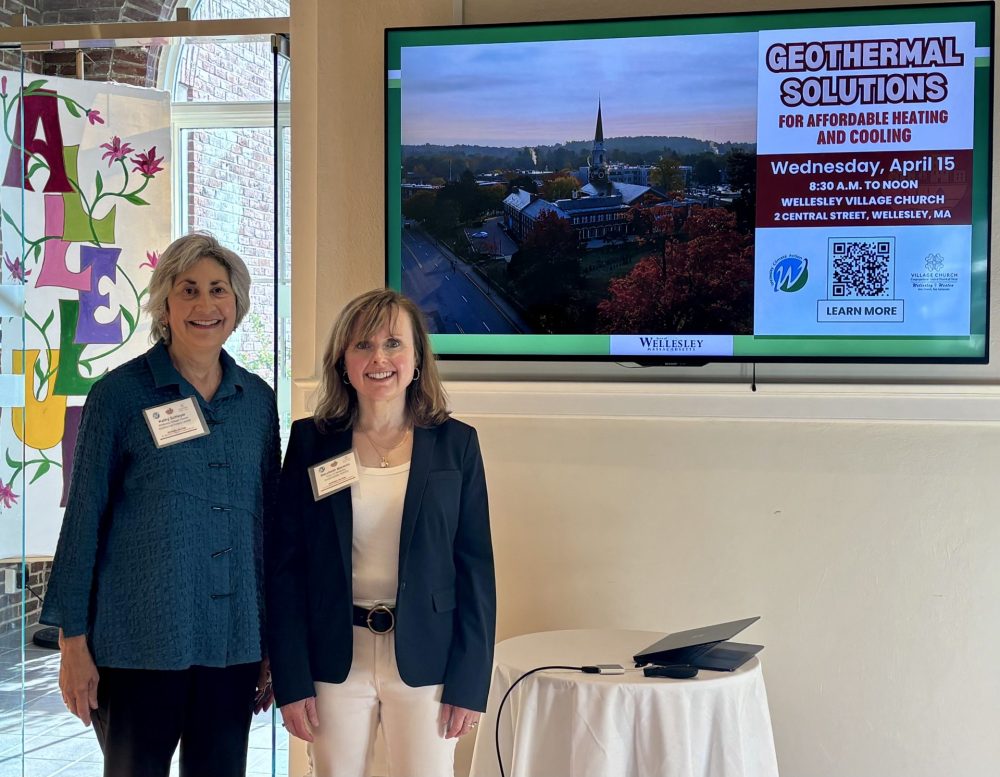
The decision to implement a geothermal heating and cooling solution, which took years to finalize, was influenced by the church’s congregation and community members, who advocated for a move away from fossil fuels.
“One of our missions of course is to help care for the earth and the health of the world, and so we’re sharing this geothermal project with you with those goals in mind,” said Schleyer.
Caitlin Osepchuk, associate and architect at HMFH Architects, hopes the church’s lead towards a greener lifestyle will inspire residents to adopt their own renewable heating and cooling systems.
“We’re starting to see that this is something that is extremely achievable in a small scale residential area or in large scale public community building cities,” she stated. “I think in terms of implementation and actually getting it into the works, it will be mostly community buildings, libraries, town halls, schools who have a little bit more capital funding behind them to, you know, offset that high initial cost.”
Isabel Varela Gutierrez, director of science at HEET, a non-profit working towards implementing climate solutions, said geothermal installations are possible on any building type, including residential buildings. However, she stated it is better to have a network of buildings that use one geothermal system, such as community centers and the Village Church. “University campuses are generally easy because they have multiple buildings,” she said.
GreenerU, an organization focussed on achieving climate neutrality through engineering sustainable solutions, helped design and install the geothermal system for the Village Church. The long-term reliability of geothermal systems outweighs the initial higher first cost on installation, said Rob Durning, chief executive officer of GreenerU.
It is recommended for buildings that are going to be around for long periods of time. While the initial cost of geothermal installation is higher than traditional natural gas and air-source heat pump systems, geothermal solutions are twice as efficient because their cost of maintenance and replacement is less, said Durning.
The Village Church faced a $2 million cost of replacement for a failing heating and cooling system, which urged their move to the geothermal systems. The church found that federal rebates and incentives meant the final cost for geothermal was about $2.05 million as opposed to the initial cost of $4.5 million. Natural gas and air-source heat pump systems’ final cost would have been around $2.07 million despite having a lower initial cost, Durning showed. Schleyer said the Village Church’s move to geothermal was a cost-effective long-term decision.
“It was so inspiring to see so many folks excited to learn and brainstorm around improvements for our communities,” said Megan Lim, an MIT graduate student who founded Geo@MIT, a student consulting group for affordable decarbonization through thermal energy systems. “I’m excited to think about how we can highlight this story and enable more intergenerational collaboration around climate and community issues.”
“Bringing groups together to explore practical solutions to help transition to cleaner, more efficient systems is essential to meet our climate goals. However, we know that this transition must extend to affordability, comfort, and resilience,” said State Rep. Alice Peisch, who also attended the forum. “I think it’s remarkable what the potential is for the geothermal systems.”