The first meeting of the Wellesley Town-wide Capital Planning Committee zoomed in on big ticket capital projects underway or under consideration that would provide much needed services or facility upgrades but that also could have a huge impact on property tax bills in the years ahead.
(See Wellesley Media recording of the entire roughly 2-hour June 16 meeting.)
Discussions of forming CapCom (TWCPC didn’t quite pass the marketing test) have been ongoing for the past year, and the concept met with some suspicion early on over whether the Select Board might gain too much control over capital projects. The Board voted in favor of a Town-Wide Capital Planning Committee policy earlier this year, and the CapCom ultimately formed consists of elected officials, department heads, and a citizen representative in Thomas Goemaat. Members introduced themselves to each other and the public to kick off the first meeting, which was held remotely.
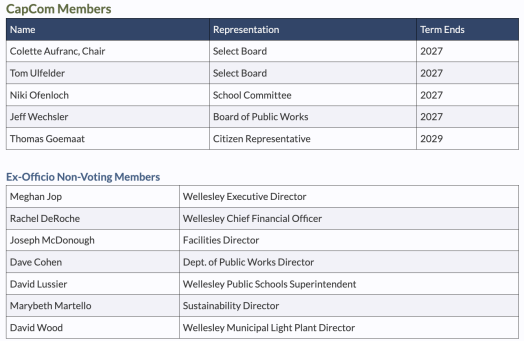
Committee Chair Colette Aufranc, who serves on the Select Board, said CapCom provides a coordinated, long-term approach to major capital planning.
“There are compounding pressures emerging within the town’s capital program, which are posed by the number, scale, and complexity of the major capital projects proposed by the town boards and departments to be undertaken over the next five to 10 years…,” she said. “It is impracticable to assess the projects and their total impacts on the taxpayers and the municipal operations independently of one another, and thus the creation of this committee.”
Summer can’t come fast enough for Wellesley following this spring of angst from one end of town (MassBay) to the other (North 40) and in between (the schools). CapCom is raising the profile of even more challenges and opportunities for the town to mull later in the year and beyond in the face of hundreds of millions of dollars’ worth of possible capital projects.
The group plans to reconvene in September and into winter to weigh and prioritize proposed capital projects, and develop a 10-year capital plan that will be updated annually. CapCom will make recommendations to the Select Board, including about project funding and delays, and prepare a written report to back its direction. A caveat is that the capital plan is subject to change based on any number of factors.
The town is seeking to make the public aware of CapCom and potential future capital plans through a dedicated webpage as well as email and text notifications. You can also email the group at capcom@wellesleyma.gov. Between these methods, meeting recordings on Wellesley Media, public forums, social media, neighborhood chat groups, and reports on a modern news site in The Swellesley Report that’s read by tens of thousands monthly, the town has more and better ways than ever to engage with the public on this important topic.
Aufranc was followed by Tom Harrington, town counsel, who shared an overview of town bylaws governing capital projects. Among his points was that the Select Board has delegated a portion of its authority to CapCom, which he said would consider only projects with initial or projected costs of more than $2m, though could be assigned to review those under that level.
Up next was Rachel DeRoche, Wellesley’s Chief Financial Officer, who went over the financial implications of existing and proposed capital projects. One grabber: Wellesley could be looking at debt exclusion (temporary property tax increase) requests at seven straight Town Meetings starting next spring depending upon which projects the town pursues. Taxpayers are already paying for a handful of debt exclusions for past projects, including assorted school buildings, and could see a 30% increase on median property tax bills by the mid-2030s if certain new debt exclusions are layered on existing ones. One way to buffer or lessen such increases might be to revisit the town’s reserves policy and stash away more reserves (not an uncommon municipal practice these days). Also: possibly establishing a capital stabilization reserve.
Later in the meeting, citizen rep Goemaat raised the question of whether the town should be looking at tolerable debt and taxpayer load first and working its way back from there in evaluating projects, rather than receiving a steady stream of proposals and figuring out how to manage the costs and tax impact from there. “It all feels a bit reactive, as opposed to proactive,” he said.
Aufranc agreed that the town must understand the amount of taxes residents are willing to bear, but has needed to develop a more holistic approach to capital planning to get to that point.
The Big 10
Facilities Director Joe McDonough made much of the town’s capital project picture more tangible by presenting an overview of capital building projects (as opposed to site and other projects, like say a land or big fire truck purchase).
He went over a draft town-wide capital plan that basically builds on the sort of capital plan that the Facilities Maintenance Department has been doing since that group formed more than a decade ago. Key aspects of the new plan will include a 10-year outlook, total project cost (vs. just construction), estimated tax impact, and funding sources. Addressing a concern that town officials, board members, and members of the public have had, McDonough said the process should keep pricey studies from “going stale” and potentially having to be updated with supplemental consulting work as might be the case on a number of possible school projects.
In highlighting 10 big capital projects either in the works or up for discussion, McDonough said he and his team have been working to categorize them. The estimated $8m Morses Pond bathhouse and beach project, now in the design phase with construction expected to start in 2028, is furthest along in addition to the estimated $17m school air conditioning project, which many in town would love to see done yesterday, especially in light of the hot finish to the school year that staff and students recently withstood (construction is estimated to start two years from now—the bulk of the work consists of electrical updates).
The two big propoals that need CapCom’s most immediate focus are an envisioned DPW Campus/Municipal Service Building project that earned Town Meeting approval in the spring for feasibility study funds and the more recently discussed fire department master plan, which features a recommended new fire station, possibly at the North 40. The DPW project could have an overall cost of $100m and the fire department project could cost up to $73m based on current projections.
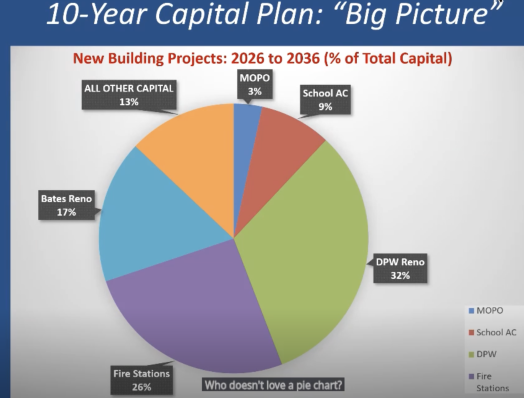
A handful of possible school projects will be nailed down further through a separate but related school facilities strategic plan. Then there is an assortment of possible maintenance projects, including those focused on roofs and HVAC systems.
To be more specific, these projects are:
- Middle School roof
- Library HVAC
- Sprague school roofing
- Sprague heating & ventilation
- Bates school roofing
- Schofield school roofing
On the school project front, McDonough described some alternative approaches that could cost significantly less. For example, a full roof replacement at the middle school could run the town $10.6m, whereas a cyclical replacement option could cost less than $1m every four or five years until the building is replaced.
McDonough also covered logistical matters for the committee, such as the forms from project proponents that it will need to processed and a CapCom decision tracking log.
- Stay informed: Sign up for Swellesley’s weekday email newsletter
- Support your local news source: Consider making a tax-deductible donation
- Keep us in the loop: Message us with tips, ideas, photos etc.: theswellesleyreport@gmail.com





$100M for DPW sounds like a boondoggle to me. Why on earth would they need such an insanely high amount? Maybe contractors on the board aren’t the best idea. Get an accountant in there.