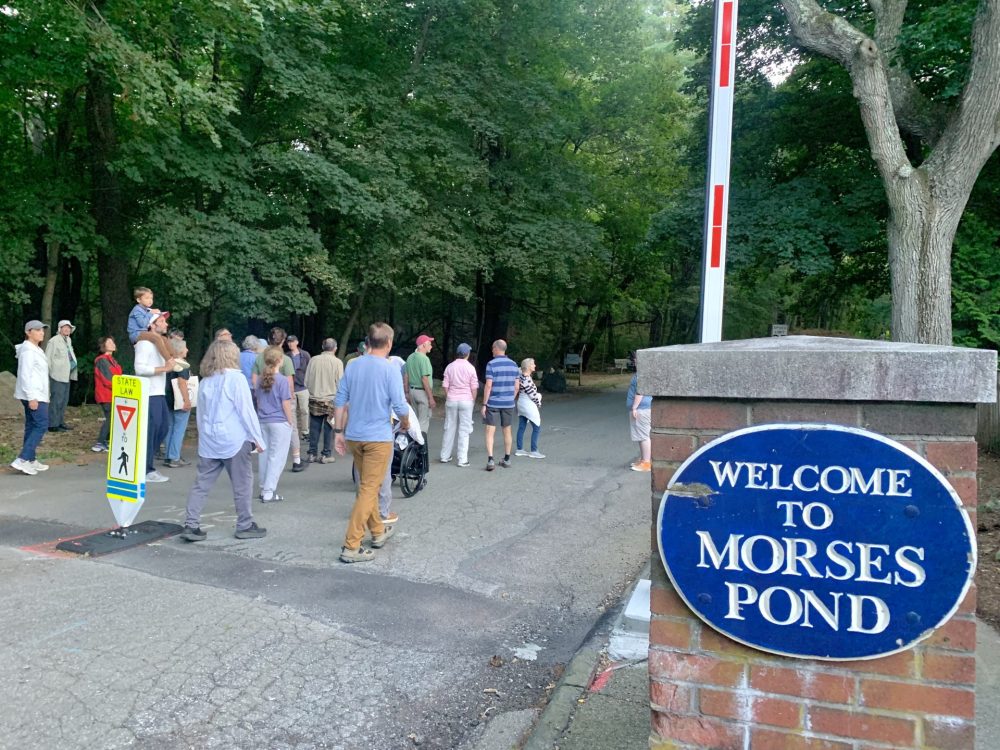
As dusk settled over Wellesley, a expectant crowd of thirty gathered at the Turner Road gate, off Weston Rd. The scent of DEET was in the air, along with a sense of excitement. Adults and kids were gathered to see bats and learn about these often misunderstood mammals.
Leading the twilight excursion was Wellesley Conservation Land Trust (WCLT) board member and naturalist Bill Giezentanner. As the group moved down the access road, heading down toward the quiet waters of Morses Pond, the forest began its nightly transition. The daytime songbirds fell silent, and the true custodians of the night sky began to flit about.
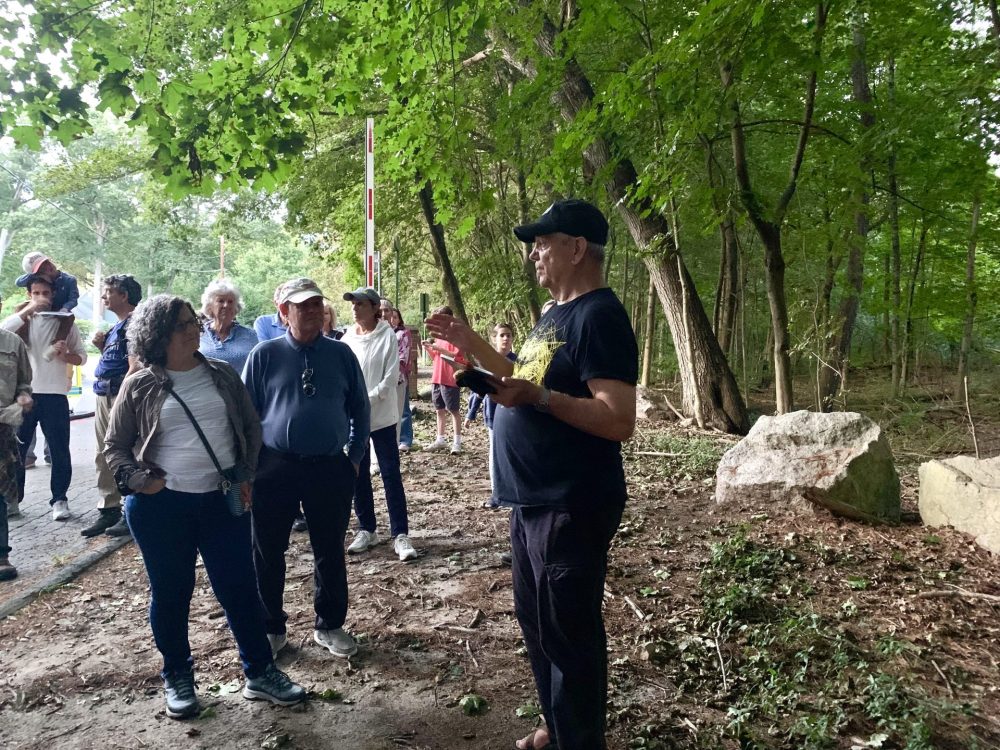
Armed with his trusty bat detector, Bill spoke about New England’s bat populations the challenges they face, and why humans need these creatures. All nine species of bats residing in Massachusetts are insectivores, fulfilling a vital ecological role. A single bat can devour a few thousand mosquitoes in a single night. Despite the presence of bats overhead, a few of the insects dared to break through the bat gauntlet to pester some in the crowd, attracted, no doubt, by the cloud of carbon dioxide produced by our breath.
Bill broke down the bat species particulars. The Eastern Red Bat, the Hoary Bat, and the Silver-Haired Bat are migratory travelers that head south for the winter, while the rest make Massachusetts their year-round home. During the summer months, Little Brown Bats and Big Brown Bats often choose human neighbors, preferring to roost in attics, barns, and building walls. Tri-colored bats, Eastern Small-Footed Bats, Indiana Bats, and Northern Long-Eared Bats tend to retreat deeper into the wilderness, taking up residence in hollow tree trunks and quiet woodland shelters.
Throughout the walk Bill held up a bat detector, an electronic device designed to pick up high-frequency ultrasonic echolocation calls and translate them into sounds human ears can perceive. Several Little Browns were darting about and although not swarming in the dozens, there were more than enough to captivate the onlookers and make the evening a true bat walk.
But sight of these tiny flyers was bittersweet. Bill explained the tragic history hanging over local bat populations.
A struggle for survival
The Little Brown Bat was once the most abundant bat species in Massachusetts. Indeed, Mrs. Swellesley recalls hundreds upon hundreds of them flying out of the chimney of her junior high school during outdoor fife and drum corp practice at dusk on warm summer evenings in the 1970s. It was quite a site. (As for why bats in the school, let’s just say Hamden, CT adopted a “live and let live” philosophy toward the creatures.)
Little Browns moved from commonplace to rare after White-Nose Syndrome reached American shores in 2006. The deadly fungal disease was accidentally introduced into an upstate New York cave by a European visitor carrying spores on their gear. The fungus infects bats while they hibernate, disrupting their deep winter sleep and causing them to burn through crucial fat reserves until they starve to death. Because European bats coevolved with the fungus, they are unaffected, but North American populations had no natural immunity.
The devastation was catastrophic. According to MassWildlife, Little Brown populations in Massachusetts plummeted by more than 99%. Overall, the disease killed about 90% of cave-hibernating bats in affected regions. In 2012, MassWildlive listed all four cave-hibernating species as endangered. (The Little Brown Bat, Northern Long-eared Bat, Eastern Small-footed Bat, and Tricolored Bat.)
Yet, as Bill pointed out, there is hope. Researchers believe surviving local bats may finally be developing a tolerance to the fungus, following in the footsteps of their European counterparts. Recent years have shown gradual signs of a slow, fragile rebound.
In fact, as the group stood listening near the shoreline, the bat detector suddenly kicked into action. The device flagged the sound as belonging to a Tricolored Bat—one of the state’s most severely threatened, endangered species. Bill examined the readout with a seasoned eye, acknowledging he wasn’t 100% convinced the detector’s automated identification was correct. But the possibility alone was a highlight for the walk and enough for Bill to tell the group he would report the audio log and location details to MassWildlife for further analysis.
Guided home by the moon
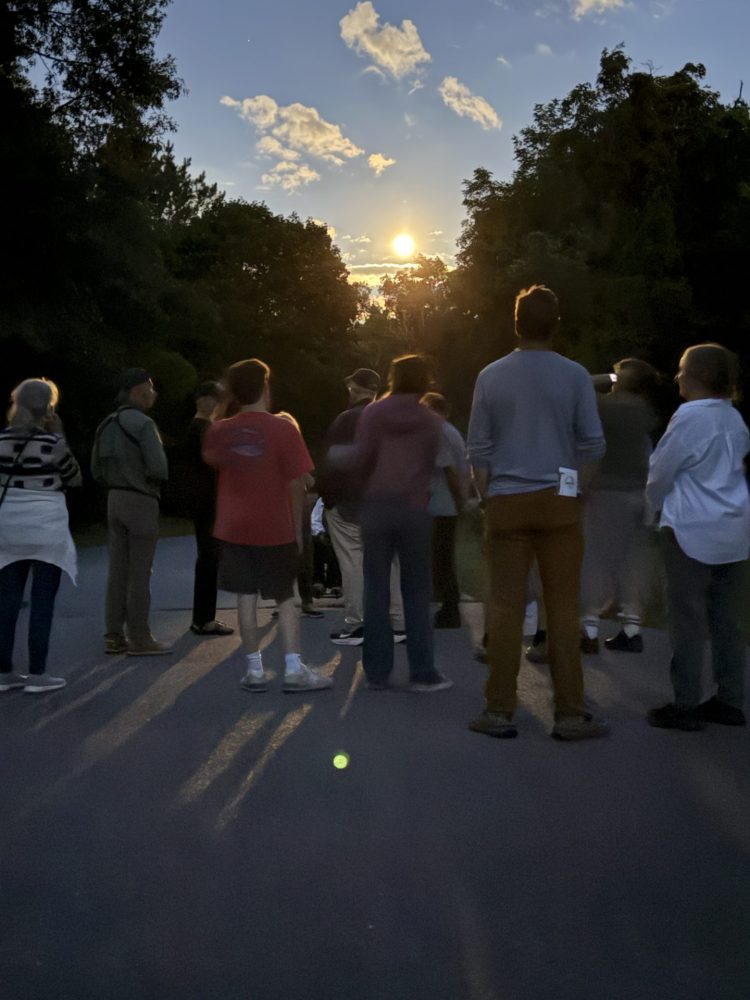
As the group made its way from Morses Pond back to the Turner Road gate, a brilliant waxing gibbous moon rose gracefully above the tree canopy, lighting the way back to everyone’s waiting cars.
Upcoming outdoor activities
No registration required for the following trail walks, and all walks are free. Walks take place unless it pours rain and there are high winds. Participants are encouraged to wear sturdy footwear.
TRAIL WALK: Wellesley Trails Committee Walk, North 40
DATE/TIME: Friday, Sept. 18, 10am-11:15am
LOCATION: Meet on Turner Road near the vernal pooL, which is near the Weston Road end of the street
DISTANCE: 1.0 mile
The North 40 offers a wide range of interesting sites and history. You will see a vernal pool, 500-foot-long boardwalk, community gardens, the aqueduct, a huge and unique seedling tree and more. You will also learn of the Crosstown trail, of which North 40 is a part of.
EVENT: Wellesley Trails Committee, Morses Pond Kids Trail Day
DISTANCE: 1.0 miles
DATE/TIME: Saturday, Oct. 3, 10:30am – 12:30pm
An annual highlight when kids delight in exploring nature in the beautiful woods at Morse’s Pond. Every year, the children enjoy looking for treasure boxes using letterboxing (written clues). Refreshments served at the end of the activities. Children must be accompanied by an adult. Meet at the Morses Pond beach parking lot. From Weston Road, follow Turner Road to the entrance to Morses Pond.
TRAIL WALK: Wellesley Trails Committee, Town Forest -1.6 miles
LOCATION: Meet at Longfellow Pond parking lot. Use this address for GPS: 204 Oakland St., Wellesley.
DATE/TIME: Saturday, Oct. 17, 10am – 11:15am
There is so much more than the loop around Longfellow Pond! The Town Forest is the largest reservation in Wellesley and supports a wide variety of wildlife and birds in a natural environment. Walk along the Longfellow Pond shoreline and climb to the top of a spectacular high esker deposited by glaciers and then back at the pond, view the summer residence of Chief Maugus and his Algonquin tribe.