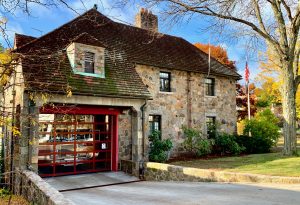
Wellesley residents gathered at Town Hall on June 25 for a forum on the Wellesley Fire Department’s Fire Station Master Plan, which proposes the construction of a new headquarters that would replace the century-old station in Wellesley Square that is small, outdated and poses risks to the firefighters’ health. The current 40-year-old WFD headquarters on Rte. 9 west (aka, station 2) would become a substation.
Context Architecture, the consulting firm spearheading the project, first presented the plan to the Select Board on June 2. There, Jeff Shaw, the firm’s president, said the ideal location for the station was 156 Weston Rd., which is within the town-owned North 40 property acquired from Wellesley College in 2014. This site is across from Curve Street; another possible location is at 156 Weston Rd. across from Howe St.
At the recent forum (see Wellesley Media recording), attendees raised numerous concerns with the site selection, citing issues pertaining to traffic, safety, environmental impact and the potential removal of the Weston Road Community Garden.
Glenn Remick, a Wellesley facilities project manager, said at the meeting that the purpose of the forum is to collect feedback from the community to consider while developing the criteria and scope for the feasibility study, which will assess how viable the recommended locations are.
Diane Dautoff, a resident of The Bristol, a condominium complex adjacent to the North 40, and board member of the Homeowners Association, said the board’s main concern is the preferred location being in a “thickly settled area.”
As a resident in the area, she said the streets are too narrow for drivers to make room for fire vehicles. She also said that the heavy traffic in the area would strongly hinder the station’s ability to meet its goal of a four-minute response time.
WFD Chief Steve Mortarelli said the department already travels frequently down Weston Road and emphasized that the new headquarters location would be an improvement geographically from the Wellesley Square location in terms of response time. Still, he echoed Remick’s statement that such concerns will be “dealt with” during the feasibility study.
Many Weston Road Community Garden participants also attended the meeting, expressing concern regarding the impact the construction could have on the space.
Diane Anderson, a longtime gardener at Weston Road Community Garden, said while she is in support of the project, she hopes that there is a solution that does not “come at the cost of one of the precious green spaces that helps make Wellesley so special.”
“The garden brings together people of different ages, backgrounds and cultures, while also providing habitat for birds, pollinators and a place for residents to connect with nature and with the earth,” Anderson said. “Is paving over a thriving community garden really the legacy we want to leave for this town?”
Meghan Jop, Wellesley’s executive director of general government services, said it is estimated that two acres of the community garden will be destroyed if the station is built on the North 40. However, she emphasized that the town has not closely analyzed this yet because the site has not been finalized.
Lisa Moore, environmental educator and outreach coordinator for Wellesley’s Natural Resource Commission, said if the station were to be on the North 40, it could pose a threat to the environment and residents’ health.
Moore said firefighters often deal with carcinogenic chemicals that are washed off the equipment and apparatus.
“Where is that water gonna go?” she asked. “It’s going to go into Morses Pond and poison us.”
Morses Pond, she explained, is the town’s major watershed, meaning residents use its water for everyday purposes, such as drinking, showering and cooking.
Mortarelli agreed with the fact that the department’s firefighters are frequently exposed to many dangerous chemicals, but explained that the new headquarters aims to make significant improvements from the unsanitary conditions of the existing station. Currently, he said, there is no separate area from the living quarters for the firefighters to wash their gear.
“That’s one of the major reasons why we’re exploring this, is because that’s a major challenge for us, and it’s posed many, many health risks to a lot of not only our retired but our active firefighters,” he said.
Some meeting attendees asked about another of the plan’s recommended, though less preferred, locations: 515 Washington St., which is adjacent to the police station and across from the senior center.
The consulting firm determined the site is less ideal because it has an aqueduct running through it, limited future flexibility, and Article 97 restrictions, which require legislative action and compliance due to its protected land status, Remick said.
Amy McCarron, a Precinct B Town Meeting member, said she is married to a first responder, so she really wants to support the project. However, she said the two recommended Weston Road locations do not make sense to her, as it would mean placing a very large municipal building into a residential neighborhood.
The alternative location is located next to other municipal buildings, which would cause “far less disruption,” she said.
“I’m begging you to please give us a plan that we can support, because we want to support you guys. You’re so important to our community, and we want to make sure you’re safe. But if this moves forward this way, I don’t think that this is going to pass.”
Please send tips, photos, ideas to theswellesleyreport@gmail.com





We are inviting a disaster to our eco space by letting huge money rule our space and human interaction. Construction for 7 years will ruin eco system, create noises and traffic that we will all be impacted for years and while they can build firestation next to a police station, their emphasis on gardens shows that they have no concern about people or nature.
I agree with the sentiments about the gardens. We have so little open space that it seems tragic to take what little we have away from us. I see so many generations getting together and socializing and learning from each other at the North 40 and would hate to see this treasure disappear. Also, I see so many people walking with their dogs and young kids there. It provides a form of recreation for everyone. have been a gardener at the North 40 for about 20 years now and would selfishly like to continue. But I worry more about other people for whom it is a major source of socialization and exercise as they age.
Thank you for this update. As a fellow first responder, I also carry risks to health and safety.
I also know that there are regular OSHAA safety inspections exactly for these reasons. So I’m confused. How are we getting the determination that there is a clear & ongoing risk to health and safety? Which neutral agency has officially stated this?
Also, if there is formal documented designation: is there a reason we cannot renovate the existing structure piecemeal? Many of us have lived through significant renovations in our own homes, to prevent the costly and disruptive need to move entirely (much less destroy our natural resources in order to do so, as in the case of deforesting the North 40 Woods).
As a resident of Thomas Road, I agree with the feedback provided by those of us who live in the North Forty area and would be most impacted by a new fire station there. I travel on Weston Road almost every day to run errands in Linden Square and Wellesley Square. This part of Weston Road is thickly settled and very well-traveled. It is also narrow for two-way traffic as it is, and the new, high sidewalk curbs would prevent vehicles from pulling over onto to the sidewalk to make room for a firetruck to pass. I say locate the new fire station next to Police Department headquarters on Washington Street. I also say convert the old Wellesley Square fire station into a community arts facility for the people of Wellesley.
As always, we appreciate your objective and balanced summaries of these discussions!