I’m a pretty early riser, but some local gym rats have me beat—as apparently do the actual vermin that they increasingly find themselves jumping over, running around, or accidentally kicking in Wellesley Lower Falls when exercising outside their workout spot.
I did venture out before the crack of dawn one morning in late August to catch up with these fitness enthusiasts and see for myself what they were telling us about in emails with subject lines such as “Local rat infestation.” I got to the location at 5:30am on the dot, and immediately saw a few rats using bait traps as an obstacle course. Apparently, if I’d gotten there 15 minutes earlier when it was darker, I would have seen many more rats, some performing acrobatics on the fence.
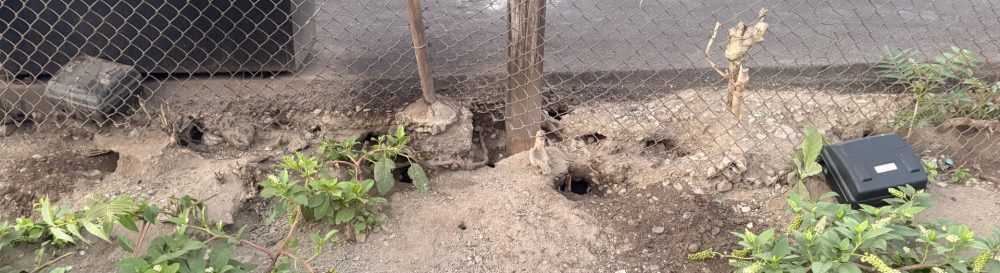
I’m keeping the exact location of where I went vague here, to protect nearby businesses that have nothing to do with creating the rat issue. But the problem is something of an open secret and a worrying one given the infectious diseases rats carry.
We spoke or emailed with owners or managers of three of the businesses in the area, and all are frustrated. “It smells like a farm out there,” says one, and there’s no actual farm anywhere nearby. Another lamented the fact that property owners weren’t working together to try to resolve the issue.
One workout participant told me the problem has been worsening throughout this year. Those who regularly see the rats have reported the issue to the Wellesley Health Department and tell us they have been dissatisfied with efforts to address the problem; the department says it has been on top of the situation but that improving it will take time.
While bait traps have been added by property owners in the area we visited—we saw about a dozen such black boxes in a fairly small space—we’ve been told that the rat colony has been able to thrive in a dirt berm between two paved surfaces. Those running into the rats would love to see that gap sealed.
The rodent problem at this site isn’t isolated. One business owner told me of a restaurant parking lot in another part of town that seemingly “moves” after hours. We separately received email from a reader who was aghast at seeing pest control workers spraying one early September morning at CVS in Linden Square near food (CVS has acknowledged pest control challenges in the recent past). “I am shaking. I am so upset and disturbed by this,” wrote the reader, who was with two young children at the time.
Chuck Danielson, who runs Integrated Pest Control in Sherborn and has been in the field for decades, says problems with rats and house mice have been bad “up and down the east coast” for at least 4-5 years. “People need to know what’s going on with these rats,” he says.
(An event called the National Urban Rat Summit will be held in Boston next week if you really are interested in knowing more.)
Danielson’s seen it all, including once catching 65 rats in a Natick house where hoarding was taking place. He’s not surprised about the rise of rats in Wellesley given all the restaurants.
“Every one has a dumpster. If you feed the rats, they’re going to be there,” he says, noting that even with regular emptying and no overflow rats can sneak into some dumpsters through drain holes or chew through some covers.
Female rats can have four or five pups every other month, he says, and mice can have six to eight every other month. So it doesn’t take long for their numbers to grow.
Board of Health takes on the rats
The Wellesley Health Department, too, acknowledges the rise in rodents in town (and beyond), particularly in commercial areas, and says it has been taking steps to address the situation. The increase began before the pandemic, but the town has seen larger numbers since then, with the shift to more people eating outside and more frequent droughts both seen as contributing factors. Rats, like us, need their food and water.
Wellesley has also been attracting more restaurants, not that anyone is complaining about that. Though some are looking to open where it’s not easy to have dumpsters, and that’s a concern for town health leaders.
In the the town’s FY 2025 annual report, under “Animal and Rabies Control,” 120 rodent inspections is shown. It’s hard to do year-to-year comparisons, though, because of the way the data has been shared publicly.
The rise of rodents has become a regular topic for discussion at Wellesley Board of Health meetings (see Wellesley Media recordings of the Sept. 15 meeting, about 52 minutes in, and Aug. 25, about 9 minutes in). The department in late August cited having received about a dozen complaints, some of them repeats.
Lenny Izzo, director of community and public health in Wellesley, told us that “We are aware of significant rodent activity in lower falls. Unfortunately we are not unique as most communities are having similar increases.” During the Aug. 25 meeting, Izzo says at one point “we are plagued with rodents across the board,” adding in chipmunks, squirrels, and more.
Following an uptick in complaints this summer, Health Department personnel visited the area in Lower Falls and met with nearby food service businesses. It then followed up by reaching out to all property owners to try to come up with a coordinated response.
“Fortunately, the food services and their individual pest control companies have not reported any activity inside their business. All of the issues we noted has been outside,” Izzo says.
The best practice underway in this area involves removing organic material, laying down wire mesh, and covering it with crushed stone, Izzo says. The process of eliminating burrows has possibly increased rat visibility in the short term as the vermin scramble for new accommodations.
“These situations take time to eliminate,” Izzo says.
Adam DiPersio, senior environmental health specialist for the town, says getting property owners and their pest control companies to work together is key. Otherwise, a pest control effort at one location can drive critters to others, and possibly undo their recent pest control work. The Health Department strives to take an educational approach with businesses and residents, though could be forced to bring a property owner or business before the Board of Health if issues persist.
Izzo added that he has met recently with those from other Wellesley departments to discuss potential town-wide changes to combat increased rodent activity.
While rat problems have surfaced largely in commercial areas, questions have been raised at Board of Health meetings about possible issues in more residential neighborhoods in light of more people using private companies for trash pickup. Izzo says that with consolidation in that industry, he’s seen less well managed operations, and that the department has received more and more complaints related to trash barrels.
Is this news to you? Please consider supporting Swellesley’s independent journalism with a tax-deductible donation.





Need to remove and contain the food waste source properly. Other states have trash bins that effectively keep out animals. If we can restrict their food source they will move elsewhere. And the rabbits are another whole issue. Basically cuter vermin.
Those blood thinners also kill the owls, Hawks, and bald eagles that are the natural predators to rats. Bald eagles, an endangered species, are dying around here to the consequences of rat poison.
New York City are using other techniques such as hormonal baits that make the rats sterile.
Let’s use something smarter than poison. I can’t believe Wellesley doesn’t have an alternative. We had owls talking to each other in our back yard late one night last fall. We will lose this magic for our kids to enjoy.
I wish that the Town could find an effective way to reduce the rabbits that are destroying our gardens.
Those black boxes contain SGARs, Second generation anticoagulant rodenticides. Those poisons kill the rats, chipmunks, squirrels or other animals that eat the bait by causing internal hemmoraging. Then when a predator like a fox or coyote or owl or other animal eats that dead contaminated rat, it also dies from hemmorage. This compounds the rat problem as you are also killing off their natural predators. Poisons should never be the first option.
I am 110% ok with the black boxes containing SGARs. Given the enormity of the infestation, getting rid of the rats is a the number one priority. Rats bring the risk of disease, urinate on everything and invade food kitchens, especially after closing time-rats have a field day crawling all over kitchens in nearby restaurants. If we need to lose a few squirrels, chipmunks, coyotes in the process, then that is ok by me. Those animals are not endangered-in-fact we are overpopulated with those animals anyway.
thank you! i deliver mail in Wellesley and see dead hawks and crows everywhere.
wildlife rehabs are inundated with poison foxes.
SGRS are not ok. When someone’s dog eats a poisoned bird and dies than everyone will complain about the SGRS. There are always many more options than poison.
Thank you for saying that. There are better ways than rodenticides to get rid of rats.